
SMILE vs LASIK vs CLEAR: Which Vision Surgery Is Right for You
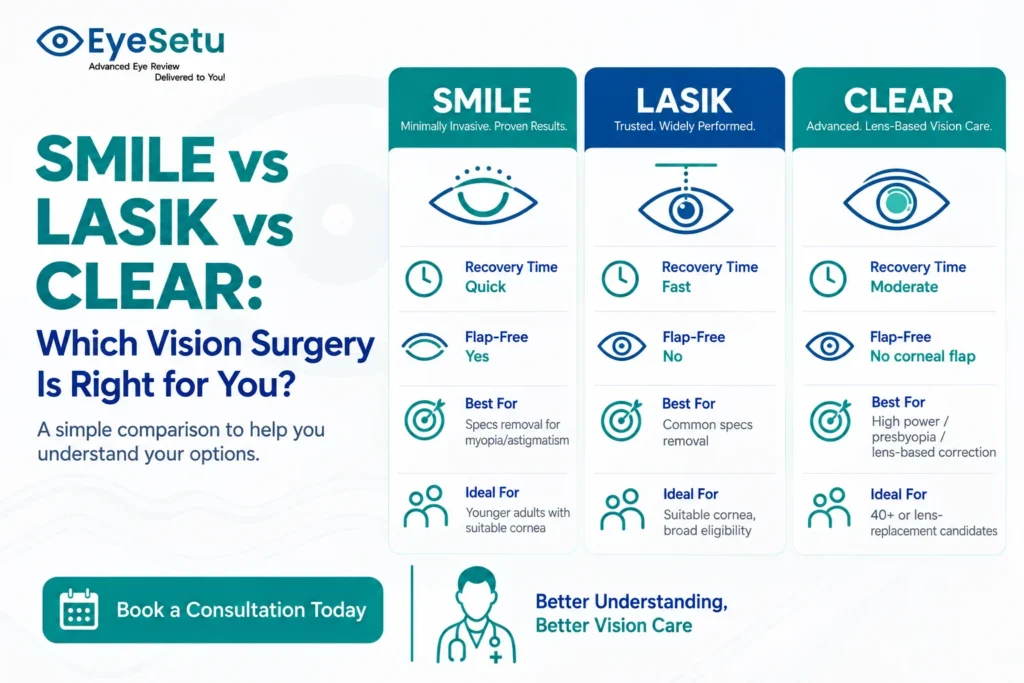
LASIK, SMILE and CLEAR all use a laser to reshape the cornea and correct your vision. LASIK works under a thin flap, while SMILE and CLEAR are flap-free and work through a tiny 2 to 4 mm opening. Which one suits you depends on your corneas and prescription, and that’s decided in a proper eye assessment.
If you’ve started researching how to get rid of your glasses, you’ve probably been hit with a wall of acronyms. LASIK, Contoura, SMILE, SMILE Pro, CLEAR, PRK, ICL. Every hospital website seems to promote whichever machine it owns.
This guide explains the three most-asked-about options in plain language, so you can walk into a consultation knowing which questions to ask.
First, what all three have in common
Your cornea is the clear, dome-shaped front window of the eye. It does most of the focusing. If you’re short-sighted, it’s slightly too steep for the length of your eye, so distant objects look blurred.
All three procedures fix this by removing a precise, microscopically thin amount of corneal tissue to flatten the curve. The difference lies in how they get to that tissue.
How LASIK works
LASIK (laser-assisted in situ keratomileusis) has been performed worldwide since the 1990s. As the US FDA explains, it uses an excimer laser to permanently reshape the cornea.
1. A thin, hinged flap is created on the surface of the cornea, usually with a femtosecond laser in modern centres.
2. The flap is folded back.
3. An excimer laser reshapes the tissue underneath.
4. The flap is laid back down, where it seals without stitches.
In India you’ll often hear about variants like topography-guided LASIK (sometimes marketed as Contoura). These use a detailed map of your cornea to customise the treatment. The basic flap-based procedure is the same.
Strengths: It treats the broadest range of powers, including short-sightedness, long-sightedness and astigmatism. Most people see well within a day. The track record goes back decades.
Trade-offs: Creating the flap cuts more corneal nerves, so dry eye in the first few months is more common. The flap never regains full original strength, so a hard, direct blow to the eye years later can, rarely, dislodge it.
How SMILE works
SMILE (small incision lenticule extraction) uses a single femtosecond laser. According to the American Academy of Ophthalmology, the laser creates a small, lens-shaped piece of tissue (a lenticule) inside the cornea, which the surgeon removes through a tiny incision.
There’s no flap, and the surface of the cornea is mostly left intact. The newer version, SMILE Pro, uses a faster laser so the laser part takes only seconds.
Strengths: No flap means fewer corneal nerves are cut, so early dry eye tends to be less. EyeWiki’s review of lenticule extraction surgeries cites a study in which 80% of SMILE patients had stopped all eye drops by six months, compared with 57% after LASIK. There’s also no flap to dislodge, which is why it’s popular with people in contact sports, the armed forces and the police.
Trade-offs: It mainly treats short-sightedness and astigmatism. Vision can take a few days longer than LASIK to reach its sharpest. If a touch-up is ever needed, it’s usually done with a different technique.
How CLEAR works
CLEAR (corneal lenticule extraction for advanced refractive correction) is built on the same idea as SMILE: a lenticule is created inside the cornea and removed through a small incision, with no flap. The difference is the platform. CLEAR uses a femtosecond laser from a different manufacturer, with low-energy pulses and built-in OCT imaging that lets the surgeon check and adjust the planned cuts after the eye is positioned.
Strengths: It offers the same flap-free benefits as SMILE. Some surgeons like the imaging and the flexibility in how the eye is held during the procedure.
Trade-offs: It’s newer, so there’s less long-term data than for LASIK or SMILE, and fewer centres in India offer it. Early results are encouraging, but if long-term track record matters most to you, ask your surgeon how many CLEAR procedures they have performed.
SMILE vs LASIK vs CLEAR at a glance
| LASIK | SMILE | CLEAR | |
| How it works | Flap lifted, tissue reshaped by excimer laser | Lenticule removed through keyhole incision | Lenticule removed through keyhole incision |
| Flap | Yes | No | No |
| Incision | Flap edge around much of the cornea | About 2-4 mm | About 2-4 mm |
| Powers treated | Short sight, long sight, astigmatism | Mainly short sight and astigmatism | Mainly short sight and astigmatism |
| Visual recovery | Usually within 24 hours | Usually 1-3 days to sharpest vision | Usually 1-3 days to sharpest vision |
| Early dry eye | More common | Less common | Expected to be similar to SMILE |
| Track record | Since the 1990s | Over a decade, widely used | Newer, less long-term data |
| Often suited to | Wide range of prescriptions, including long sight | Active lifestyles, contact sports, uniformed services, mild dry eye | Similar to SMILE, where available |
For most people with a normal prescription and healthy corneas, all three give excellent results. The differences are about comfort, recovery and lifestyle, not about which one “works better”.
Who shouldn’t have any of the three
None of these procedures is right for everyone. Surgery is usually not advised, or needs extra caution, if:
• You’re under 18, or your prescription has changed in the last year
• Your cornea is too thin, irregular, or shows signs of keratoconus
• You’re pregnant or breastfeeding, as hormones can shift your prescription
• You have uncontrolled diabetes or certain autoimmune conditions
• You have significant dry eye that hasn’t been treated
• Your power is very high, where an implantable lens (ICL) may be safer
The FDA’s LASIK resource has a detailed section on when the procedure may not be suitable. A good surgeon will tell you if you’re not a candidate rather than steering you to a procedure anyway.
Questions worth asking at your consultation
• Which procedure do you recommend for my eyes, and why not the other two?
• Are my corneal thickness and corneal map within safe limits?
• How many of these procedures have you personally performed?
• What happens if I need a touch-up later?
• When can I go back to work, screens, the gym and travel?
A surgeon who answers these clearly, and doesn’t rush you into a decision, is a good sign.
How to decide: start with the right tests
The choice between SMILE, LASIK and CLEAR is made after detailed tests: corneal mapping, corneal thickness, tear film assessment and a stable prescription over at least a year. Online quizzes can’t do this.
The first step is simple. An EyeSetu eye test at home confirms your current prescription and checks for issues like dryness that need attention before any surgery. If you’re keen to explore laser correction, our team can guide you on the detailed pre-surgery workup and coordinate the surgical pathway with partner hospitals through our SurgiSetu programme. You can read more about how EyeSetu’s home eye care works.
Ready to find out whether you’re a candidate? Book an eye test at home in Delhi or Gurugram.
Frequently asked questions
Which is better, SMILE or LASIK?
Neither is better for everyone. LASIK treats a wider range of prescriptions and gives very fast visual recovery. SMILE is flap-free, tends to cause less early dry eye and suits active lifestyles. Your corneal measurements decide which is safer for you.
Is CLEAR the same as SMILE?
They use the same principle: a lenticule is removed through a small incision, with no flap. CLEAR uses a different laser platform with built-in imaging. It is newer, with less long-term data than SMILE.
How long does recovery take after laser eye surgery?
Most people see well within a day after LASIK and within one to three days after SMILE or CLEAR. Mild dryness, glare or halos at night can take a few weeks to a few months to settle fully.
Who is not a candidate for laser vision correction?
People under 18, those whose prescription changed in the past year, people with thin or irregular corneas or keratoconus, pregnant or breastfeeding women, and people with untreated severe dry eye or uncontrolled diabetes.
Wondering if you’re a candidate for SMILE, LASIK or CLEAR? Start with a home eye test or call +91-9899118310, and our team will guide you through the next steps.
This article is for general education and does not replace a personal eye examination or surgical consultation.