Hospital-Grade Eye Care at Home: What Makes EyeSetu Different
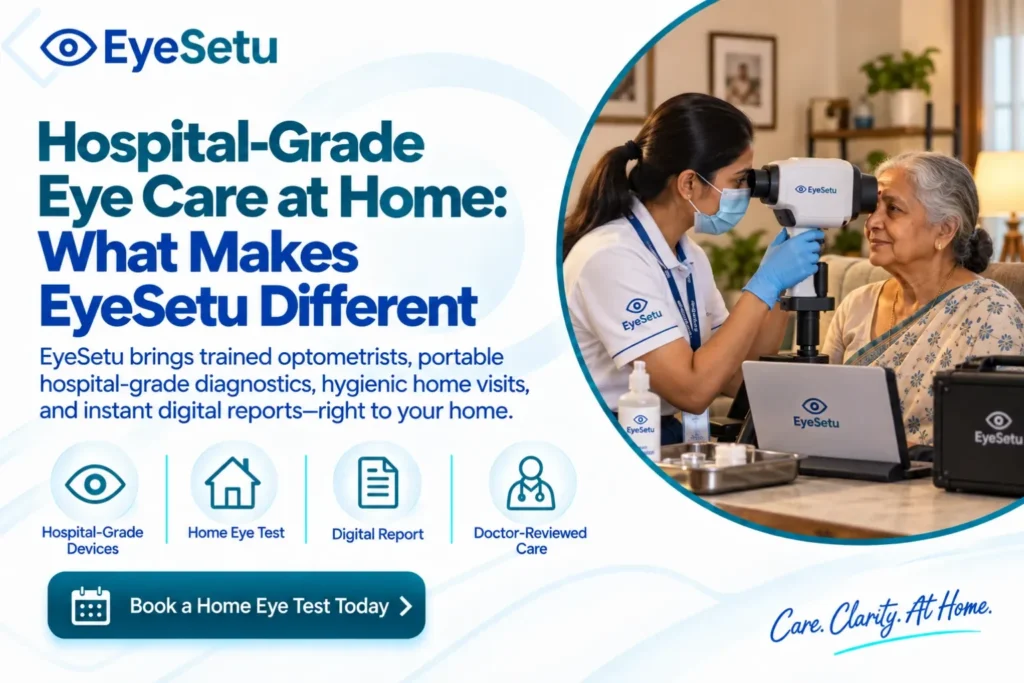
“Home eye test” has become a fairly crowded search term over the last couple of years, which is generally a good thing — it means more families are taking eye health seriously enough to look for convenient options. It also means it’s worth asking what actually separates a properly run clinical service from something closer to a basic vision-chart-and-a-torch visit with a good marketing page.
Here’s an honest look at what specifically defines how EyeSetu operates, without the usual vague claims.
It Was Built by a Practicing Ophthalmologist, Not a Logistics Company
EyeSetu was founded by Dr. Shikha Gupta, an MD in Ophthalmology from AIIMS (gold medalist), who spent 17 years at AIIMS RP Centre — one of North India’s leading ophthalmology institutes — as a resident and later a consultant, before starting EyeSetu. She’s also a recipient of the American Glaucoma Society Humanitarian Award and was ranked among the top 2% of Stanford-listed researchers in India for 2025 — a background profiled in detail by Startup Pedia after EyeSetu crossed 1,500 patients served.
This matters more than it might initially seem. A service built by someone who spent nearly two decades watching patients arrive with advanced, preventable vision loss — often because getting to a hospital simply wasn’t practical for them — tends to be designed around actual clinical priorities, not just convenience as a selling point.
The Equipment Is the Same Category Used in Hospitals
A lot of what determines whether a home eye test is genuinely useful comes down to the equipment. EyeSetu uses FDA-approved, clinic-grade diagnostic tools — portable versions of the same technology used in hospital settings, covering vision and refraction testing, intraocular pressure measurement, slit lamp examination, fundus photography, and where clinically needed, OCT and visual field testing for glaucoma and retina monitoring.
This is a meaningful distinction from a basic screening visit. A standard vision chart can tell you if someone needs glasses. It can’t tell you if someone has early-stage glaucoma or diabetic retinopathy — conditions that require the kind of imaging and pressure measurement equipment most “quick eye check” services don’t carry.
Every Result Is Reviewed by an Ophthalmologist, Same Day
The testing itself is conducted by trained optometrists during the home visit, but the results are then reviewed by an AIIMS-trained ophthalmologist — often Dr. Shikha Gupta herself — through a live teleconsultation the same day. This isn’t a delayed report emailed a few days later with no opportunity to ask questions; it’s a real, two-way clinical conversation happening as part of the same visit.
Care Doesn’t Stop at Diagnosis
Where EyeSetu differs most from a typical “testing service” is what happens after a diagnosis. The SurgiSetu programme provides end-to-end coordination for cases needing surgical intervention — pre-operative workup, scheduling at partner hospitals including iClinix’s centres across Delhi NCR, and post-operative follow-up through home visits and teleconsultations. This closes a gap that a lot of standalone testing services leave open: finding a problem is only useful if there’s a clear, supported path to actually treating it.
Data-Driven Follow-Up, Not a One-Time Visit
For chronic conditions like glaucoma, diabetic retinopathy, and macular degeneration, tracking change over time matters more than any single test result. EyeSetu’s model includes personalised care plans with automated follow-up reminders and progress tracking, so monitoring these conditions doesn’t depend entirely on the patient remembering to book their next check-up months later.
Real Patient Feedback, Not Just a Sales Pitch
Patients who’ve used the service describe not having to visit multiple clinics for basic tests, getting quick results with proper teleconsultation support, and — for those managing glaucoma — being able to track eye pressure, visual field changes, and OCT reports more comfortably than through repeated hospital visits. Families booking for children have specifically noted how much easier the process was compared to a typical paediatric hospital visit, where getting a young child to cooperate through a long wait and unfamiliar setting is its own challenge.
Who This Is Genuinely Built For
EyeSetu is particularly suited to:
- Elderly patients for whom hospital visits are physically difficult
- Working professionals who can’t take half a day off for a routine check
- Parents of young children who test better in a familiar environment
- Chronic condition patients needing frequent monitoring without repeated hospital trips
- NRI families coordinating a parent’s eye care remotely, who need same-day results, video access to consultations, and coordinated follow-up they can track from anywhere
The Honest Limitation
To be clear about what this model doesn’t replace: actual surgical procedures happen at a hospital, not at home, and certain emergency or highly specialised cases will always require in-person hospital care. What EyeSetu is built to handle exceptionally well is everything up to that point — diagnosis, specialist screening, and ongoing monitoring — plus the coordination needed if a hospital-based treatment does become necessary.
See what a home visit with EyeSetu actually involves →
Book a visit directly →, or read more about the team behind it →