How Home Eye Tests Work: A Walkthrough for Families Living Abroad
“So someone just… comes to the house with equipment?” is a fairly common reaction the first time someone explains a home eye test to family living abroad. It sounds almost too simple, which is usually followed by a healthy amount of skepticism about whether it can really be as thorough as an actual hospital visit.
It’s a fair question. Here’s a genuine, step-by-step walkthrough of what happens from booking to final report, so there’s no guesswork involved before your family commits to it.
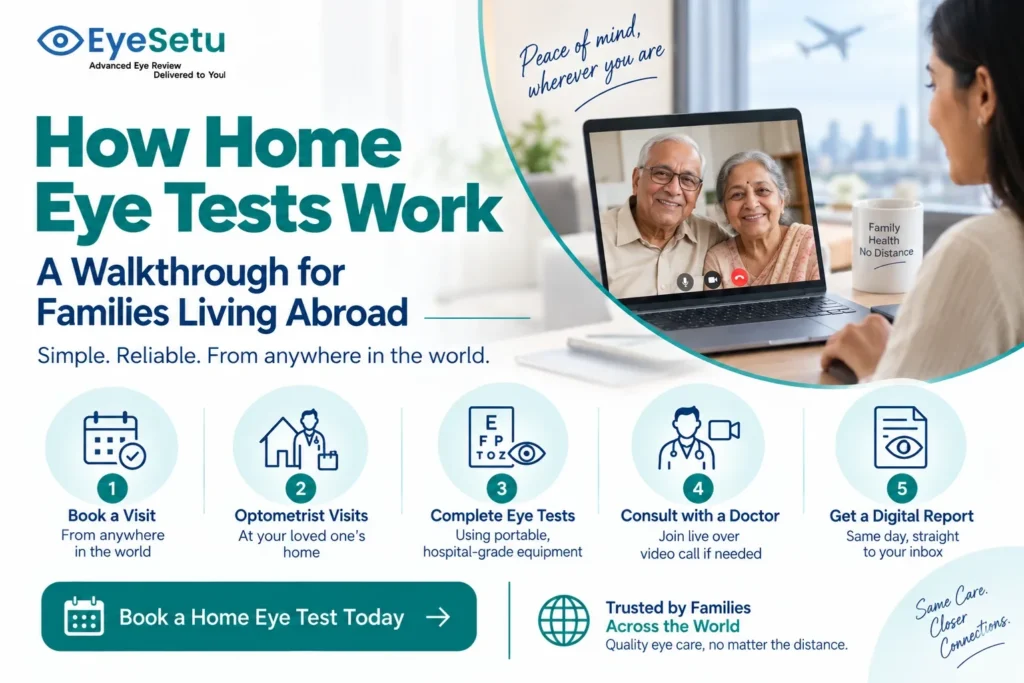
Step 1: Booking
The process starts with choosing a date, time, and location — usually done online or over a call. Home visits currently cover Delhi and Gurugram, Faridabad, and Noida. You’ll be asked a few basic questions upfront: the patient’s age, any known conditions like diabetes or existing glasses prescriptions, and the general reason for the test, whether it’s a routine annual check or something specific like blurred vision or eye discomfort. This helps the visiting optometrist come prepared with the right equipment for what’s actually needed.
Step 2: The Visiting Team Arrives With Real Diagnostic Equipment
This is usually the part that surprises people most. The equipment brought for a home visit isn’t a stripped-down version of what a hospital uses — it’s the same category of FDA-approved, clinic-grade diagnostic tools, just built to be portable, as independent coverage of EyeSetu’s model has also noted. Depending on what the visit is for, this can include:
- A digital vision and refraction unit, to measure exact prescription strength
- A tonometer, to check intraocular pressure as part of glaucoma screening
- A portable slit lamp, to examine the front structures of the eye
- A fundus camera, to photograph the retina and optic nerve
- OCT (optical coherence tomography) and visual field equipment, for more detailed glaucoma or retina monitoring, where clinically indicated
The optometrist sets up in a normal room in the house — nothing more specialised than good lighting and a bit of space is required.
Step 3: The Actual Testing
A standard visit takes around 30 to 45 minutes, depending on age and what’s being tested. For older adults or anyone with a known condition, it can run a bit longer since more detailed imaging may be involved. For children, the process is adapted to be quicker and more engaging, since holding a young child’s attention through a lengthy exam isn’t realistic.
Nothing about the testing itself is uncomfortable. Most of it involves looking into a device for a few seconds at a time, following a light, or reading letters or symbols from an adjustable distance.
Step 4: Same-Day Review by an Ophthalmologist
This is the step that makes the whole model work clinically, not just logistically. The results from the visit are sent digitally to an ophthalmologist — often Dr. Shikha Gupta or another AIIMS-trained member of the team — who reviews the findings and joins a live teleconsultation call the same day. This isn’t a delayed callback days later; it happens as part of the same visit.
Family members based elsewhere, including abroad, can join this consultation remotely if they’d like to hear the findings directly rather than through a secondhand account.
Step 5: A Digital Report, Explained in Plain Terms
After the consultation, a digital report is generated covering what was tested, the results, and the recommended next steps — whether that’s a glasses prescription, a treatment plan, or a monitoring schedule for something like glaucoma or diabetic retinopathy. The doctor also explains this over the call in plain language, not just clinical shorthand, so the patient (and any family member on the call) actually understands what it means.
Step 6: Follow-Up, If Needed
If a condition needs regular tracking, the team helps set a reasonable follow-up schedule — typically every 3 to 6 months for chronic conditions, or annually for routine monitoring. If the results point toward something requiring more than monitoring, such as cataract surgery, the SurgiSetu programme takes over from there: coordinating pre-operative workup, surgery scheduling at a partner hospital, and post-operative follow-up care, so the patient (or the family managing things from a distance) isn’t left to arrange all of that independently.
What Doesn’t Happen at Home
To be transparent about the limits of this model: actual surgical procedures, obviously, aren’t performed at home — those happen at partner hospitals through the SurgiSetu coordination process. Extremely specialised or emergency situations may also require an in-person hospital visit rather than a home consultation. The home visit model covers diagnosis, routine and specialist testing, and ongoing monitoring extremely well; it’s the treatment execution for surgical cases that shifts to a hospital setting, with the coordination handled on the patient’s behalf.
Frequently Asked Questions
Is the equipment used at home as accurate as hospital equipment?
Yes. The diagnostic tools used are the same category of FDA-approved, clinic-grade equipment used in hospitals, adapted to be portable. Accuracy isn’t reduced — what changes is where the test happens, not the standard of the test itself.
How long does a home eye test usually take?
Around 30 to 45 minutes for a standard adult exam, sometimes longer if detailed imaging for a condition like glaucoma is needed. Children’s exams are typically shorter and structured to hold their attention.
Can family members join the consultation remotely?
Yes, the teleconsultation happens over video, so anyone — including family based abroad — can join the same call and hear the findings directly from the ophthalmologist.
What happens if the test finds something that needs surgery?
The SurgiSetu programme takes over from diagnosis, handling pre-operative workup, scheduling at a partner hospital, and post-operative follow-up, so the patient or family doesn’t have to independently arrange each step.
Why This Matters for Families Abroad Specifically
For NRI families, the value here isn’t just convenience — it’s the same-day loop of testing, doctor review, and a documented report, all of which can be accessed and understood remotely. You don’t need to be in the room to know exactly what happened, what was found, and what happens next. That’s a meaningfully different experience than the usual pattern of a parent going to a hospital alone and relaying a partial, sometimes inaccurate summary over a phone call days later.