Can You Join Your Parent’s Eye Consultation on Video From Abroad?
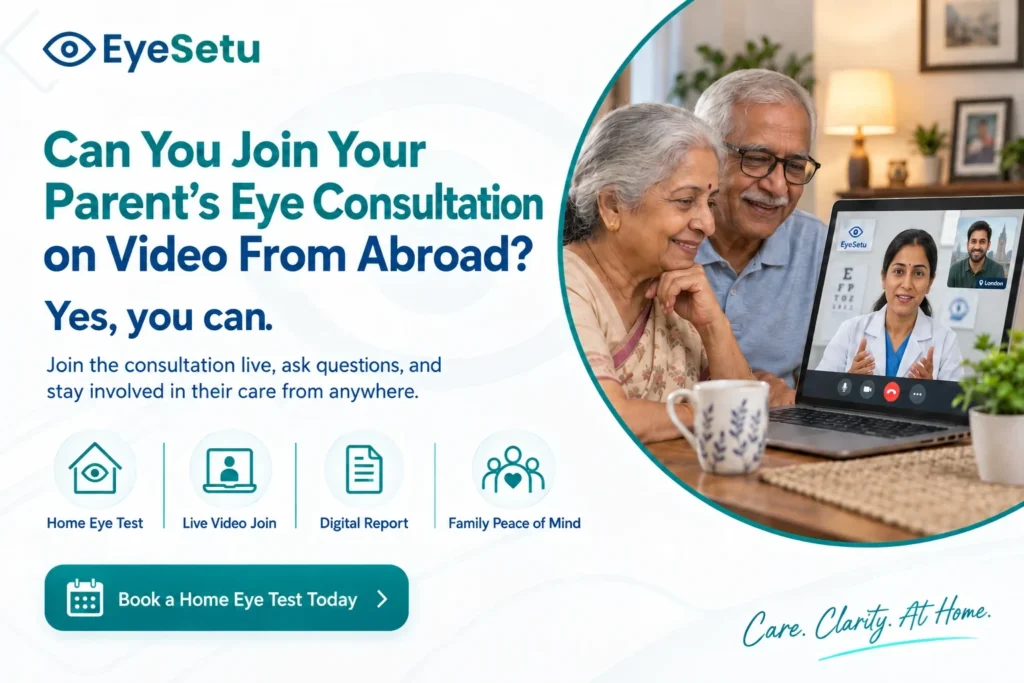
Short answer: yes, and it’s genuinely one of the more useful parts of the whole process for families managing a parent’s care from another country. Here’s exactly how it works, what you’ll actually see and hear on the call, and a few practical things worth knowing before you join one.
How the Teleconsultation Fits Into the Visit
When a home eye test is booked, an optometrist visits the parent’s home first to run the actual diagnostic tests — vision and refraction checks, intraocular pressure measurement, imaging of the retina, and anything else relevant to what’s being investigated. Once that’s done, the results are sent digitally to an ophthalmologist, who then joins a live video consultation the same day to go through the findings.
This is the point where you can join too. The call isn’t a separate appointment you need to schedule independently — it’s part of the same visit, happening shortly after the tests are completed. Video-based teleconsultation for exactly this kind of remote family care has been formally recognised and regulated in India since the Telemedicine Practice Guidelines were issued by the Ministry of Health in 2020, which gave doctor-led video consultations the same legal standing as an in-person visit.
What You’ll Actually See on the Call
The ophthalmologist — often Dr. Shikha Gupta or another AIIMS-trained member of the team — will typically walk through the results using the same reports and images captured during the visit, explaining what was found in plain language rather than dense clinical terminology. If a retinal photo shows early signs of a concern, or a pressure reading is outside the normal range, you’ll see the actual number or image being discussed, not just hear a verbal summary.
This matters more than it might sound. A lot of miscommunication in remote family caregiving happens because a parent relays a doctor’s explanation secondhand, sometimes forgetting details or unintentionally simplifying something important. Being on the actual call removes that layer entirely.
Do You Need to Be There at the Start, or Just for the Consultation?
Just the consultation. The testing portion doesn’t require anyone beyond the parent and the visiting optometrist — there’s no need for you to be present, live, while vision charts and imaging are being done. Your involvement is most useful at the point where results are being explained and decisions are being discussed, which is exactly the part that happens over video.
What to Prepare Before Joining
A few things make the call more useful on your end:
- A list of questions you want answered, particularly if there’s a specific concern that prompted the test in the first place, like changes you’ve noticed on calls or something your parent mentioned in passing.
- Basic context on your parent’s medical history, if you know something they might forget to mention — a recent diagnosis, a medication change, or a family history of a specific eye condition.
- A stable internet connection on your end, obviously, though the visit itself happens with the parent’s own connection at home, which the visiting team typically accounts for.
What Happens If the Call Reveals Something That Needs Follow-Up
If the consultation identifies something requiring more than routine monitoring — say, cataracts progressing to the point where surgery makes sense — this is also a good moment to ask questions directly, since the next steps (through EyeSetu’s SurgiSetu coordination) involve scheduling, a partner hospital, and follow-up visits that you may want visibility into, especially if you’re the one keeping track of a parent’s care from a distance.
Why This Setup Works Better Than the Alternative
The alternative — a parent going to a hospital appointment alone and calling you afterward — has an obvious weak point: you’re relying entirely on their memory and their understanding of what was said, at an appointment where you weren’t present to ask your own follow-up questions. That’s not a knock on your parents’ judgment; it’s just a genuinely hard thing for anyone to relay accurately, especially if the conversation involved anything even mildly technical or concerning.
Being on the actual consultation call closes that gap. You hear the same explanation your parent hears, at the same time, and can ask anything that occurs to you in the moment rather than trying to reconstruct the conversation later from a partial retelling.
Frequently Asked Questions
Can more than one family member join the video consultation?
Yes, there’s no restriction on how many people join the call, so siblings or other family members involved in a parent’s care can all be present for the same conversation.
Is there an extra charge for joining the consultation remotely?
No, the teleconsultation is part of the standard home visit — it’s simply where the results are reviewed and explained, whether or not family members outside the home choose to join.
What if I can’t make the scheduled time due to the time difference?
The digital report and consultation summary are shared afterward, so you can review everything even if you weren’t able to join the live call. It’s still worth mentioning your general availability when booking, so the visit can be timed as conveniently as possible.
Can I ask the doctor questions directly during the call?
Yes, the consultation is a live, two-way conversation, not a recorded summary — you can ask about the results, the reasoning behind any recommendation, or what to watch for going forward.
Getting Started
If you’re planning to book a home eye test for a parent and want to be part of the consultation, mention this when scheduling so the visit can be timed with your availability in mind, given the time difference. The test itself happens on the parent’s schedule; the consultation call is where your schedule gets factored in.