Why Glaucoma and Diabetic Screening Can’t Wait for Your Next Trip
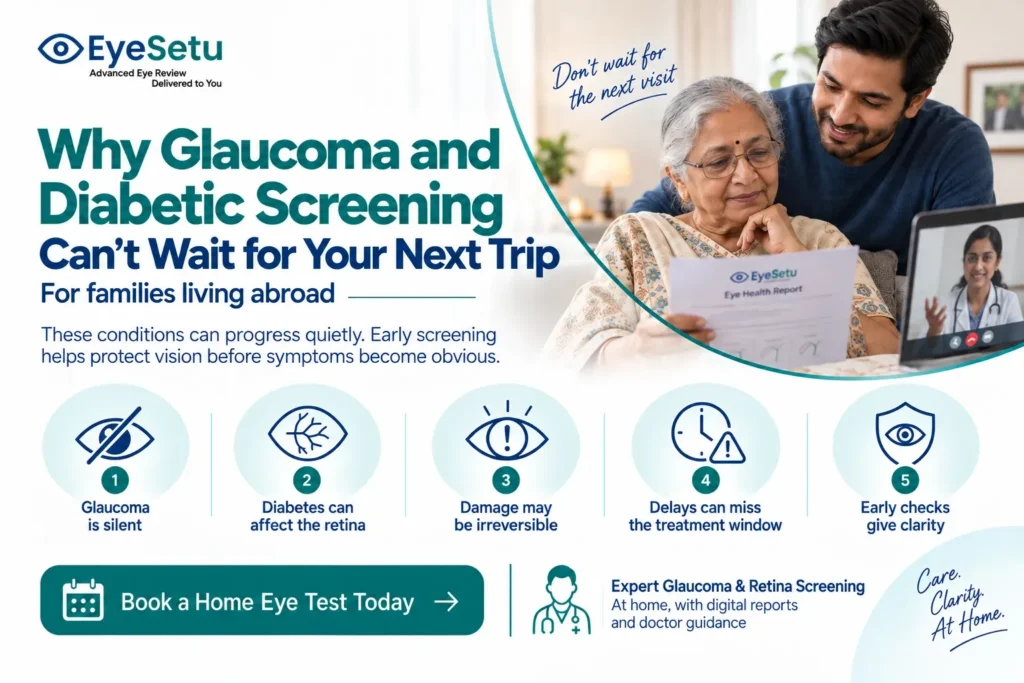
“We’ll get it checked when I’m home in December” is one of the most understandable, and occasionally one of the most costly, sentences in NRI family planning. For most health issues, a few months’ delay is genuinely fine. For glaucoma and diabetic retinopathy specifically, it can be the difference between catching a problem while it’s still manageable and catching it after permanent damage has already occurred.
Here’s why these two conditions in particular deserve a different level of urgency than “we’ll sort it out next trip.”
The Problem: Both Conditions Are Silent By Design
Glaucoma damages the optic nerve, usually as a result of elevated pressure inside the eye, and it does this by eroding peripheral vision first — the part of your visual field you’re least consciously aware of using. Central vision, the part responsible for reading and recognising faces, often stays sharp until the disease is quite advanced. This means a person can lose a significant portion of their field of vision without ever noticing anything is wrong, because the brain is remarkably good at filling in gaps at the edges of what we see.
Diabetic retinopathy follows a similarly quiet pattern. It develops when high blood sugar damages the blood vessels in the retina, and in its early stages, it typically causes no symptoms at all. By the time blurred vision, dark spots, or vision loss show up, meaningful and sometimes irreversible damage has already been done.
Both conditions share the same dangerous trait: by the time a patient notices something is wrong, screening would have caught it months or years earlier.
The Numbers Are Not Small
India has an estimated 11.2 million people aged 40 and above living with glaucoma, and by most clinical estimates, roughly 80% of them are undiagnosed. That’s not a niche statistic — it means the vast majority of people who currently have glaucoma in India don’t know it yet, including, quite possibly, someone’s parent who “sees just fine” by their own account.
Diabetes prevalence in India is similarly significant — the country is often described as the world’s diabetes capital, with roughly one in five adults affected — and diabetic retinopathy is one of the leading causes of preventable blindness among working-age and older adults with the condition. Anyone managing diabetes for more than five years is considered to be at meaningfully elevated risk, regardless of how well their blood sugar feels controlled day to day.
Why “They’d Notice If Something Was Wrong” Doesn’t Hold Up
This is the assumption that causes the most delay, and it’s worth addressing directly. Vision loss from glaucoma or diabetic retinopathy doesn’t announce itself with obvious symptoms early on — there’s no pain, no sudden blurriness, nothing that would prompt a parent to say “something feels off with my eyes.” The person experiencing early-stage vision loss often has no internal signal that anything is happening at all.
This is precisely why these conditions are screened for, rather than diagnosed based on complaints. A parent who insists their eyes are “absolutely fine” can still be in the early-to-moderate stages of either condition — that reassurance genuinely isn’t reliable evidence one way or the other.
What Screening Actually Involves
For glaucoma: intraocular pressure measurement (tonometry), examination of the optic nerve, and where needed, visual field testing and OCT imaging to assess for early nerve damage before it becomes clinically obvious.
For diabetic retinopathy: fundus photography to examine the retina directly for the small blood vessel changes, leakage, or bleeding that mark the disease’s progression, sometimes supplemented with OCT if changes are detected.
Neither test is invasive or uncomfortable, and both are quick enough to be part of a single home visit alongside a standard eye exam.
How Often Screening Should Actually Happen
- Adults over 40 with no known risk factors: every 1 to 2 years
- Adults with diabetes: at least once a year, regardless of how vision feels, starting from diagnosis
- Anyone with a family history of glaucoma: annually from age 40, since genetics meaningfully raises risk
- Anyone already diagnosed with either condition: every 3 to 6 months, since both require ongoing monitoring rather than a one-time check
If a parent falls into any of these categories and hasn’t been screened in the timeframe above, that’s the practical trigger to act now rather than wait for a family visit.
Dr. Shikha Gupta, who spent 17 years treating glaucoma patients at AIIMS RP Centre before founding EyeSetu, puts it plainly: “The patients I worry about most aren’t the ones who come in with complaints — those cases we can usually manage well. It’s the ones who show up because a routine screening caught something they had no idea was there, sometimes with vision already permanently reduced in one eye. Screening exists specifically because you can’t rely on symptoms to tell you when it’s time.”
Why Distance Makes This Worse, Not Just Inconvenient
For NRI families, the “we’ll handle it next trip” instinct is understandable — coordinating anything medical from abroad is genuinely more effort. But with glaucoma and diabetic retinopathy specifically, the gap between visits is exactly the window during which irreversible damage tends to happen. A parent who was screened clear two years ago isn’t necessarily still clear today, and waiting for the next visit home to find out means potentially losing 6 to 12 months of a window where treatment could have preserved vision that’s now permanently gone.
Getting Screening Done Without Waiting for a Flight
This is precisely the gap home eye testing is built to close. EyeSetu’s home visits in Delhi, Gurugram, Faridabad, and Noida include glaucoma, diabetic retinopathy, cataract, and age-related macular degeneration (ARMD) screening as part of a comprehensive eye exam, using the same category of diagnostic equipment found in hospitals — tonometry, fundus photography, and OCT where indicated. Results are reviewed the same day by an AIIMS-trained ophthalmologist, with a digital report you can access and review yourself, wherever you are.
You don’t need to be in Delhi for your parents’ eyes to be properly checked. You just need to book it.
Book a glaucoma and diabetic eye screening for your parents →