Why You Suddenly Need Reading Glasses After Turning 40 in India
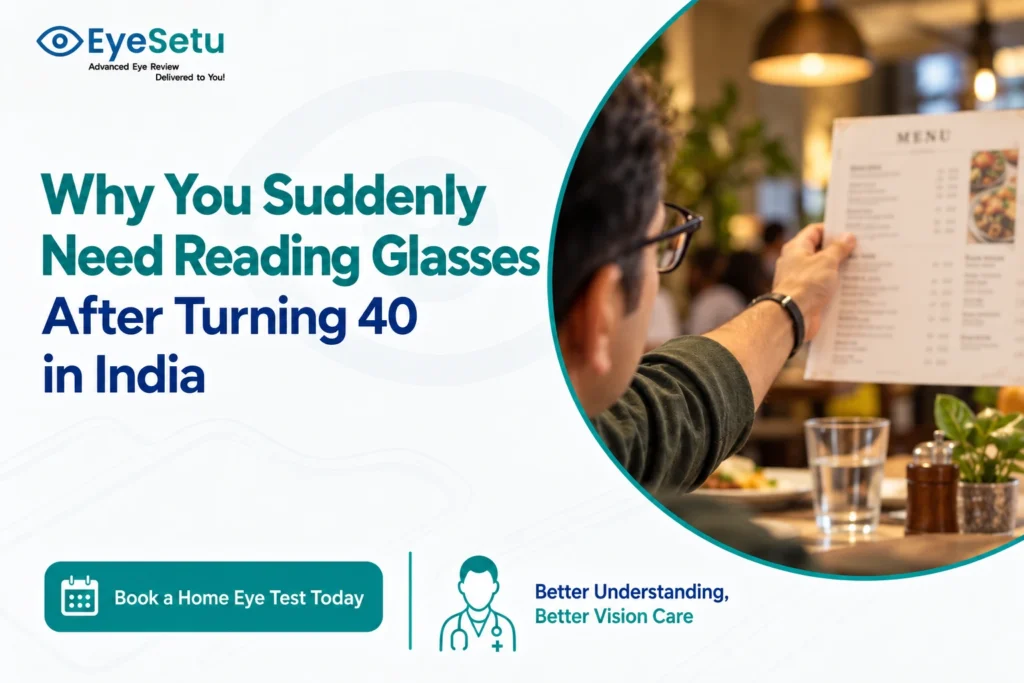
Presbyopia is the reason most people need reading glasses after 40. The lens inside the eye slowly stiffens with age, so focusing on close-up text gets harder. It’s normal, it can’t be prevented, and it’s easy to correct.
For most people it starts with something small. The WhatsApp forward with tiny text. The dosage line on a medicine strip. The bill at a restaurant, which you now hold a little further away and tilt towards the light. You might joke that “your arms have got shorter”.
You haven’t suddenly damaged your eyes, and you haven’t done anything wrong. You’ve reached the age where almost everyone’s near vision starts to change. Here’s what’s going on, and what to do about it.
What is presbyopia, in plain words?
Inside your eye sits a clear, flexible lens. When you look at something close, a ring of muscle around it relaxes its pull and the lens bulges slightly, bending light so the image lands sharply on the retina. That’s how a 10-year-old can read a book held almost at their nose.
From childhood onwards, that lens slowly hardens. For decades you don’t notice, because there’s plenty of focusing power to spare. Somewhere in your early to mid forties, the reserve runs out. According to the American Academy of Ophthalmology, this is a normal part of ageing and it keeps progressing gradually until around 65.
That’s why it feels sudden. The change was happening for years; you only noticed when it crossed the line of what you need every day.
Early signs you may need reading glasses
The Mayo Clinic lists the classic signs as holding reading material further away, blurred vision at normal reading distance, and eye strain or headaches after close work. In everyday Indian life, that often looks like:
• Increasing your phone’s font size, then increasing it again
• Needing brighter light to read, especially in the evening
• Struggling with labels, price tags or a thermometer reading
• Tired eyes or a headache after reading the newspaper or working on a laptop
• Taking off your distance glasses to see your phone more clearly (common for people who are short-sighted)
People who are long-sighted may notice it earlier, sometimes in their late thirties. People with diabetes, and those who do a lot of fine close work, may also notice it sooner.
Why you shouldn’t just buy readers off the shelf
Ready-made reading glasses from a chemist or a roadside stall are cheap and tempting. They can work as a stopgap, but they have real limits:
• They give the same power to both eyes. Many people need a different power in each eye.
• They don’t correct astigmatism, which is common and causes blur and strain if ignored.
• The optical centres may not match the distance between your pupils, which can cause headaches.
• Most importantly, they skip the eye check.
That last point matters more than people realise. The age when presbyopia starts is also the age when silent conditions like glaucoma, diabetic eye disease and early cataract begin to appear. The AAO recommends a full baseline eye examination at 40 for adults with no symptoms, as part of its eye health guidance for adults aged 40 to 65. Your first pair of readers is a good moment to have that check done properly.
Your options for clear near vision after 40
Once your eyes have been examined, there are several ways to manage presbyopia. The right one depends on whether you already wear glasses, your work, and how much you’re on screens.
Single-vision reading glasses. Simple and affordable. Good if your distance vision is fine and you only need help for reading. The downside is constantly taking them on and off.
Bifocals. Distance on top, reading at the bottom, with a visible line between them. Practical, though many people find the line ageing.
Progressive (multifocal) lenses. No visible line; the power shifts gradually from distance at the top to near at the bottom, with a middle zone for computer distance. Most working professionals in their forties find these the most convenient. They take a week or two to get used to.
Office or computer lenses. Set for screen and desk distance. Useful for people who spend most of the day at a laptop.
Contact lenses. Multifocal contact lenses, or “monovision” (one eye set for distance and the other for near), suit some people well. They need a careful trial.
Eye drops. Prescription drops based on pilocarpine are now available in some countries, including India. They temporarily improve near focus for a few hours. They are not suitable for everyone and should only be used after an eye examination.
Surgery. Some lens and laser procedures can reduce dependence on reading glasses, usually considered later and alongside cataract planning. It’s a conversation for a specialist, not a first step.
Will my eyes get worse if I start wearing reading glasses?
This is one of the most common worries we hear, and the answer is no. Reading glasses don’t make your eyes “lazy” or speed up presbyopia. Your near vision will keep changing until your mid-sixties whether you wear them or not. Avoiding glasses just means more strain and headaches in the meantime. You’ll probably need a slightly stronger power every two years or so.
Get it checked without the clinic queue
If you’ve started holding your phone at arm’s length, book a full eye test, not just a pair of readers. An EyeSetu eye test at home checks your vision, refraction and overall eye health, and gives you a prescription you can use for reading glasses or progressives. You can read more about how our home eye care service works and the team behind it.
If your parents are in their sixties or seventies and still using the same old readers, our ophthalmologist’s guide to the signs ageing parents need an eye check-up is worth a quick read too.
Frequently asked questions
At what age does presbyopia start?
Most people notice it between 40 and 45. Long-sighted people may notice it in their late thirties. It continues to progress gradually until around 65.
Can presbyopia be reversed or prevented?
No. It is a natural ageing change in the eye’s lens, and eye exercises or diet do not reverse it. It can, however, be corrected very effectively with glasses, contact lenses and, in some cases, drops or surgery.
Are ready-made reading glasses safe to use?
They’re not harmful for short-term use, but they don’t account for different powers in each eye or astigmatism, and buying them often means skipping an eye exam that can catch glaucoma or diabetic eye changes after 40.
How often should I get my eyes tested after 40?
A full eye examination at 40, then every one to two years, or as your eye doctor advises. People with diabetes, high blood pressure or a family history of glaucoma may need more frequent checks.
Medically reviewed by Dr. Shikha Gupta, MBBS, MD (Ophthalmology), AIIMS New Delhi. Co-founder & CEO, EyeSetu. 15+ years in clinical ophthalmology and telemedicine.
Started holding your phone at arm’s length? Get a proper near-vision prescription without the clinic queue: book an EyeSetu eye test at home or call +91-9899118310.
This article is for general education and does not replace a personal eye examination.