What Happens During an EyeSetu Home Visit? A Step-by-Step Guide
Scheduling an eye check-up often sounds simple—until you try fitting it into your day. Between work commitments, family responsibilities, and Delhi’s traffic, visiting an eye clinic can easily get pushed to “next weekend.” For many people, that weekend never comes.
That’s why more families are choosing a home eye examination Delhi. Instead of spending hours travelling and waiting for your appointment, you can receive professional eye care in the comfort of your home, at a time that suits you.
If you’ve never experienced a home eye visit before, it’s natural to have questions. Who comes to your home? What tests are performed? Is the equipment reliable? Will the examination be as thorough as one conducted at a clinic?
The good news is that a home eye examination is designed to provide the same level of professional care while making the entire experience more comfortable and convenient.
In this guide, we’ll walk you through exactly what happens during an EyeSetu home visit—from the moment you book eye test at home until you receive your results.
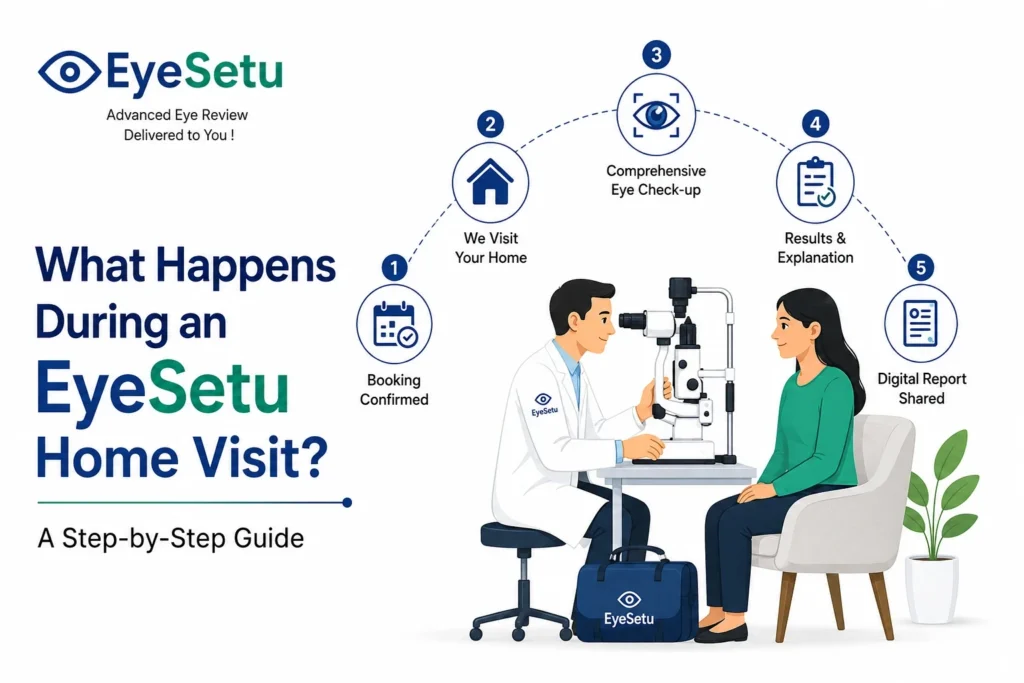
Step 1: Booking Your Appointment Is Quick and Convenient
The process begins when you decide to book eye test at home with EyeSetu.
Instead of adjusting your schedule around clinic timings, you can choose an appointment slot that’s convenient for you and your family. Whether you need an early morning visit before work or prefer an evening appointment after office hours, the goal is to make eye care fit into your routine—not the other way around.
During the booking process, you’ll be asked a few basic questions, such as:
- Your name and contact details
- Your address
- The number of people who need an eye examination
- Any existing eye conditions or vision concerns
- A preferred date and time
This information helps the EyeSetu team prepare for your visit and ensure the right equipment is available.
Step 2: Two Trained Eye Care Professionals Visit Your Home
On the day of your appointment, two trained optometrists arrive at your home with advanced, hospital-grade portable diagnostic equipment to conduct a comprehensive eye health assessment. The equipment is designed to deliver the same high standard of diagnostic accuracy typically expected in a hospital eye clinic, while allowing you to remain comfortable in your own home.
You don’t need a dedicated examination room or any special setup. A clean, well-lit space is usually enough for most assessments, and the team will take care of setting up the equipment.
Before beginning the examination, the specialists will introduce themselves, explain the process, and answer any questions you may have. They will also take time to understand your medical history, current vision concerns, lifestyle, and any previous eye conditions.
For example, you may be asked:
- Do you spend long hours working on a computer?
- Have you noticed blurred vision or headaches recently?
- Do you have diabetes or high blood pressure?
- Is there a family history of glaucoma or other eye diseases?
- Are you already wearing glasses or contact lenses?
This helps ensure that the examination is personalised to your specific needs and that the most appropriate diagnostic assessments are performed using AI-enabled imaging technology and advanced ophthalmic equipment.
Step 3: Your Vision Is Carefully Assessed
Once the initial discussion is complete, the eye examination begins.
A home eye examination Delhi is much more than checking whether you need glasses. It is a comprehensive assessment of your vision and overall eye health.
Depending on your age, symptoms, and medical history, the examination may include:
- Distance and near vision testing
- Eye power assessment
- Automated refractometry
- Colour vision screening, when required
- Eye movement evaluation
- Basic binocular vision assessment
- Digital eye strain assessment for professionals and students
- Retinal photography and fundus scanning
- Slit lamp imaging
- Intraocular pressure (IOP) measurement using a tonometer
- OCT and visual field testing, when clinically indicated
Every test is explained before it is performed, ensuring you understand what is being checked and why it matters.
Rather than rushing through the appointment, the specialist takes the time to answer your questions and explain the findings in simple, easy-to-understand language.
Step 4: Screening for Common Eye Conditions
One of the biggest advantages of choosing a home eye examination Delhi is that it focuses not only on your vision but also on your overall eye health.
Many eye diseases develop silently and may not cause noticeable symptoms until significant damage has already occurred.
During the examination, the specialist may screen for early signs of conditions such as:
- Cataracts
- Glaucoma
- Diabetic Retinopathy
- Dry Eye Disease
- Age-related vision changes
- Refractive errors such as myopia, hyperopia, and astigmatism
If anything appears unusual, you will be advised to consult an ophthalmologist for further evaluation.
As Dr. Varun Gogia, Director, ICLINIX, explains, “Many serious eye conditions, including glaucoma and diabetic retinopathy, often develop silently without noticeable symptoms. Regular eye screenings play a vital role in identifying these conditions early, when treatment is most effective.”
That is why regular eye examinations are important—even if your vision feels perfectly normal.
Step 5: Understanding Your Results
Once the examination is complete, the eye care professional will walk you through the findings. Instead of simply handing over a prescription, they’ll explain what your results mean and answer any questions you may have.
If your vision has changed, you’ll be informed whether you need a new spectacle prescription. If your eye health appears normal, you’ll receive guidance on how often you should schedule your next eye examination based on your age and medical history.
If the screening identifies anything that needs further attention, such as signs of glaucoma, diabetic retinopathy, cataracts, or another eye condition, you’ll be advised to consult an ophthalmologist for a detailed evaluation.
The aim isn’t to cause unnecessary concern—it’s to ensure that potential problems are detected early, when treatment is often more effective.
Step 6: What Happens After the Home Visit?
A home eye examination Delhi doesn’t end when the specialist leaves your home.
Based on your examination, you may receive:
- A spectacle prescription, if required
- Guidance on maintaining good eye health
- Recommendations for lifestyle changes that can help reduce digital eye strain
- Advice on when your next eye examination should be scheduled
- A referral to an ophthalmologist if additional investigations or treatment are needed
This follow-up guidance ensures you have a clear understanding of your eye health and the next steps, if any. As Dr. Shikha Gupta, Co-founder & CEO of EyeSetu, says, “Preventive eye care is one of the simplest ways to protect your vision. A routine eye examination can identify problems early, often before they begin to affect your daily life.”
To book a home eye examination, call +91-9899118310, fill out the enquiry form, or simply scan the QR code below to download the EyeSetu app from the Google Play Store or Apple App Store. With the app, you can conveniently book appointments, manage your eye care, and connect with eye care professionals whenever you need assistance.
| Download EyeSetu App on Andriod | EyeDownload EyeSetu App on iOS |
| Get it on Google Play | Download on the App Store |
Frequently Asked Questions
- Is a home eye examination as effective as visiting a clinic?
A home eye examination Delhi is suitable for routine vision assessments, eye health screenings, and identifying early signs of common eye conditions. If specialised tests or treatment are required, you’ll be referred to an ophthalmologist.
- How long does the examination take?
Most appointments take between 30 and 45 minutes, depending on the number of people being examined and the tests required.
- Should I book eye test at home even if my vision seems normal?
Yes. Many eye conditions, including glaucoma and diabetic retinopathy, may not show symptoms in their early stages. Regular eye examinations help detect these conditions before they affect your vision.
- Do I need to prepare anything before the visit?
Not really. A clean, well-lit room is usually all that’s needed. The eye care professional brings the required portable equipment.
- How often should I get my eyes checked?
Adults should ideally have a comprehensive eye examination every one to two years. If you have diabetes, high blood pressure, or a family history of eye disease, your doctor may recommend more frequent screenings.
Bringing Eye Care Closer to You with EyeSetu’s Home Eye Examination Delhi Service
Taking care of your eyes shxouldn’t feel like another task on your to-do list. By choosing a home eye examination Delhi, you’re making it easier to prioritise your vision without the inconvenience of travelling or waiting at a clinic.
Whether you’re scheduling a routine check-up, arranging an examination for your parents, or simply want the convenience of professional eye care at home, EyeSetu is committed to making the experience smooth, reliable, and patient-friendly.
If it’s been a while since your last eye examination, now is a good time to book eye test at home and take a proactive step towards protecting your vision. Call EyeSetu experts at +91-9899118310 to book your home visit. If you wish you can also fill in the booking form, and our experts will reach out to you as per your conviene.
About the Author
Dr. Shikha Gupta is the Co-founder & CEO of EyeSetu and an ophthalmologist with over 15 years of experience in clinical practice and telemedicine. An AIIMS alumna (MBBS, MD Ophthalmology, Gold Medalist), she is also the former Additional Professor, (RPC) AIIMS, New Delhi, and former Senior Consultant at AIIMS. She is committed to making quality eye care accessible to everyone through technology-driven innovation.
Medical Disclaimer
This article is intended for educational purposes only and should not be considered a substitute for professional medical advice, diagnosis, or treatment. If you experience changes in your vision or have concerns about your eye health, consult a qualified ophthalmologist.