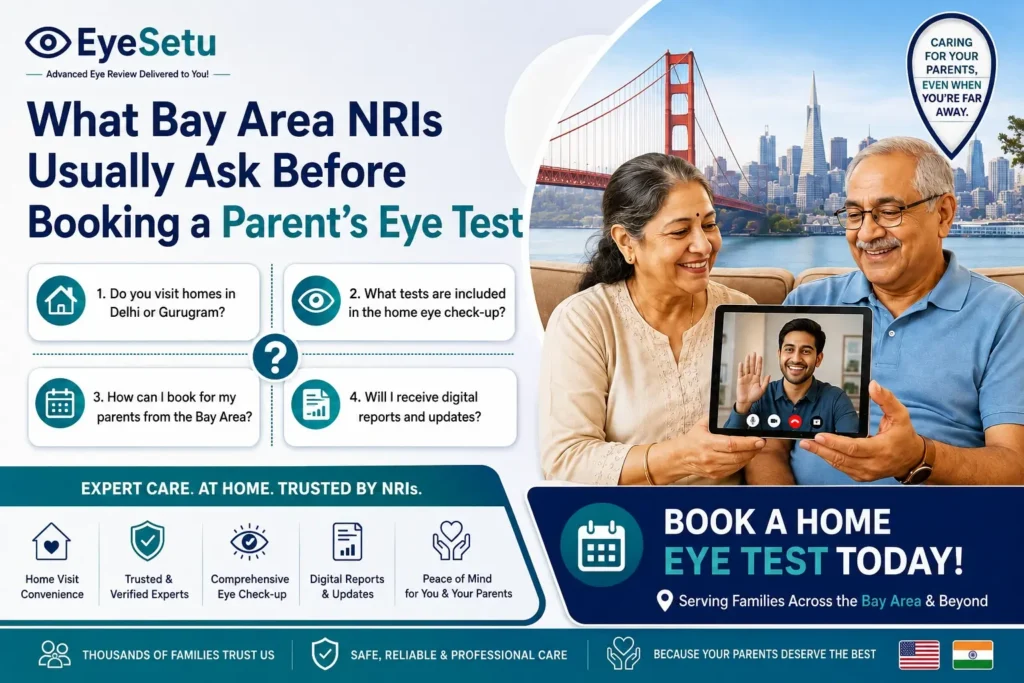
What Bay Area NRIs Usually Ask Before Booking a Parent’s Eye Test
There’s a particular kind of 11 PM search that happens in the South Bay and Fremont fairly often: “how to book eye doctor for parents in India” typed into a phone right after a call home ends on a slightly worrying note. Between the 12-and-a-half-hour time difference and not having set foot in a Delhi hospital in years, most Bay Area families end up with the same handful of questions before they book anything.
Here are the ones that come up most, answered directly.
“Can I actually book this myself, from here, without my parents doing anything?”
Yes. The entire booking can be done by you — online, or over a call — using your own contact details. You choose the appointment slot, and the confirmation, updates, and final report all come to you directly. Your parents just need to be home at the scheduled time. This is usually the detail that reassures people most, since a lot of NRIs have tried in the past to get a parent to book something themselves over the phone, and it rarely goes smoothly.
“What time will the visit actually happen, given the time difference?”
Home visits are scheduled in IST during normal daytime hours convenient for your parents, since they’re the ones being examined. If you want to join the same-day teleconsultation call live, that typically happens shortly after the visit — for Bay Area families, that often lands in the very early morning or late evening local time, depending on when the visit was scheduled. Some families choose not to join live and instead review the digital report and consultation summary the next morning their time, which works just as well.
“How do I pay from the US?”
Payment can typically be made online using an international card, which avoids the back-and-forth of trying to wire money or hand cash to a parent for reimbursement later. It’s worth confirming the exact payment options at the time of booking, since these can be updated.
“Is this actually as good as a hospital eye exam, or is it a stripped-down version?”
This is the most common hesitation, and a fair one. The equipment used during a home visit is the same category of diagnostic tools used in leading eye hospitals — not a basic chart and a torch. Depending on what’s needed, a visit can include full refraction testing, intraocular pressure measurement for glaucoma screening, slit lamp examination, and fundus photography. Results are reviewed by an AIIMS-trained ophthalmologist, not just recorded and filed. The difference isn’t quality — it’s that the equipment travels to your parents instead of the other way around.
“What if the doctor finds something serious? I’m not there to help sort out next steps.”
This is usually the real underlying worry, more than the test itself. If something requiring further care comes up — cataracts, for example — EyeSetu’s SurgiSetu programme handles the coordination: pre-surgical workup, scheduling at a partner hospital, and post-operative follow-up visits, all managed on your parents’ behalf. You’d still be kept informed and can join consultations remotely, but you’re not left trying to personally arrange a surgeon and hospital slot from a nine-and-a-half or twelve-and-a-half hour time difference away.
“My parents don’t love the idea of a stranger coming to the house. How does that usually go?”
This comes up often, particularly with older parents who are used to going to a familiar family doctor. In practice, most families find that once the first visit happens, the discomfort fades fast — largely because being tested at home, in a comfortable and familiar setting, tends to be a genuinely more relaxed experience than sitting in a hospital waiting room. It also helps to frame it to your parents as something you arranged for them specifically, rather than a generic service, since that context tends to matter to them more than the mechanics of how it works.
“Do I need to keep the reports myself, or does EyeSetu store them?”
You’ll receive a digital report after every consultation, which is worth saving on your end regardless of whatever the service retains internally, particularly if your parents are being monitored for a chronic condition like glaucoma, diabetic retinopathy, cataracts, or age-related macular degeneration (ARMD), where comparing results over time is what actually matters clinically.
“What if my parents need glasses or a specific brand of eye drops afterward?”
This depends on what’s prescribed, but the process is generally designed to close the loop rather than leave your parents to sort out logistics themselves — including guidance on where and how to get a prescription filled locally, and follow-up scheduling if a condition needs monitoring rather than a one-time fix.
“Is Delhi or Gurugram all that’s covered, or does this extend further?”
Currently, home visits are focused on Delhi and Gurugram, Faridabad, and Noida. If your parents live elsewhere in the NCR region, it’s worth checking directly whether their specific location falls within the current service area, since coverage has been expanding.
“How far in advance should I book if I know I’m planning a trip home?”
If you’re trying to time this around a visit — say, to be present for the consultation call or to handle any follow-up in person — booking a couple of weeks ahead gives enough buffer for scheduling and, if needed, a follow-up visit before you’re back on a flight.
The Bigger Picture
None of these questions are really about the mechanics of an eye test. They’re about trust — trusting that a service arranged from thousands of miles away will actually look after a parent the way you would if you were there yourself. That’s a reasonable thing to want reassurance on before booking anything, and it’s worth asking directly rather than assuming. You can read more about the AIIMS-trained team behind EyeSetu if that’s part of what you’re weighing.
This kind of long-distance coordination isn’t unique to eye care, either — it’s the same challenge covered in broader guides on managing healthcare for NRI parents in India, from insurance to routine check-ups.
Book a home eye test for your parents from anywhere →