Delhi’s Air Quality Is Falling Again: What It Does to Your Eyes
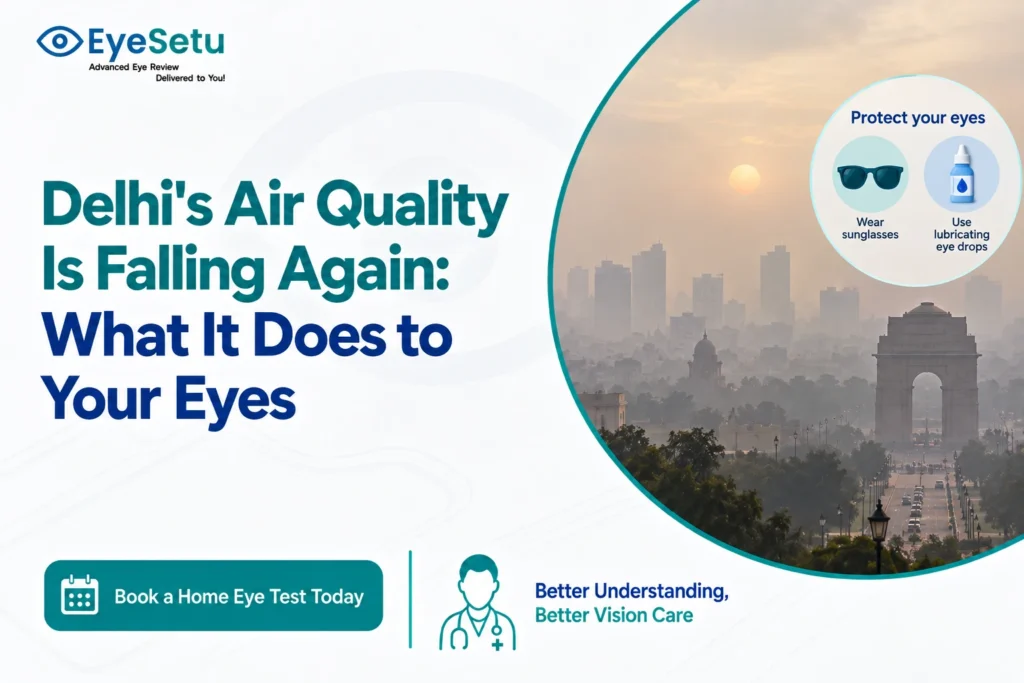
Delhi’s polluted air irritates your eyes directly, causing redness, burning, grittiness and dryness. Sunglasses, preservative-free eye drops and not rubbing your eyes help most people. If you have pain or blurred vision, get your eyes checked.
You can usually tell the smog season has arrived before you check an app. The sky turns that flat grey-white, there’s a faint smell of smoke in the evening, and your eyes start to sting on the drive home.
By late October, Delhi NCR’s air quality regularly slips into the “poor” and “very poor” bands as stubble burning, festive traffic, construction dust and cooler, still air combine. Most of the public conversation is about lungs. Your eyes, though, are one of the few parts of your body in direct, constant contact with that air.
What the AQI numbers mean
The Central Pollution Control Board’s National Air Quality Index uses six bands. It’s worth checking each morning in this season.
| AQI | Category |
| 0-50 | Good |
| 51-100 | Satisfactory |
| 101-200 | Moderate |
| 201-300 | Poor |
| 301-400 | Very poor |
| 401-500 | Severe |
On “very poor” and “severe” days, people with dry eye, allergies or contact lenses usually feel the difference first.
How air pollution affects your eyes
Your eye’s surface is protected by a thin tear film made of three layers: oil, water and mucus. It keeps the eye moist, smooth and clear. Pollutants interfere with it in a few ways:
• Particles irritate the surface. PM2.5 and dust settle on the eye and the inside of the eyelids, causing a gritty, foreign-body feeling.
• Gases and smoke trigger inflammation. This shows up as redness, burning and watering.
• The tear film becomes unstable. Tears evaporate faster, so the eye dries out even though it may also water.
• Allergies flare. Pollution can make the eye more reactive to dust, pollen and mould.
This isn’t new for Delhi. An early study published in Ophthalmologica found signs of tear-film instability in Delhi residents who had no symptoms, suggesting the city’s air was affecting eyes even before people noticed. More recently, a national analysis in Scientific Reports linked fine-particle emissions from sources like household cooking fuel, transport and road dust to the number of eye-related hospital visits across India.
Common symptoms in smog season
• Red or bloodshot eyes
• Burning or stinging, especially outdoors
• A gritty, sandy feeling
• Watery eyes (often a reaction to dryness)
• Itching, particularly if you have allergies
• Tired eyes and mild blur that clears with blinking
• Contact lenses feeling uncomfortable much sooner than usual
People who tend to suffer most include contact lens wearers, two-wheeler riders, traffic police and delivery workers, older adults, people with existing dry eye, people who’ve recently had eye surgery, and children who play outdoors.
A note for parents and older family members
Children rub their eyes more and rarely say their eyes hurt. Watch for frequent blinking, rubbing or red eyes after outdoor play, and move sports indoors on “very poor” days if you can.
Older adults are more likely to have dry eye already, and many use long-term eye drops, such as for glaucoma. If their eyes get much worse in smog season, don’t stop any prescribed drops; ask their eye doctor instead.
What actually helps
1. Wear wraparound sunglasses outdoors, even on hazy days. They act as a physical shield against particles and wind. Two-wheeler riders should keep the helmet visor down.
2. Use preservative-free lubricating drops a few times a day during bad-air weeks. They dilute and wash away particles and support the tear film. Preservative-free versions are gentler for frequent use.
3. Rinse gently with clean water when you get home, then wash your face and hands. Splashing is enough; don’t scrub.
4. Don’t rub your eyes. It grinds particles into the surface and makes inflammation worse.
5. Switch from contact lenses to glasses on “very poor” and “severe” days, if your eyes feel irritated.
6. Clean the air where you spend the most time. An air purifier in the bedroom, closed windows during peak pollution hours, and a bowl of water or humidifier if heaters dry the room.
7. Take screen breaks and blink fully. Screen time reduces blinking and makes pollution-related dryness worse.
8. Use a cool compress for a few minutes to soothe burning and itching.
What to avoid
Steroid eye drops without a prescription. Some drops sold over the counter for “red eyes” contain steroids. They can give quick relief, but unsupervised use can raise eye pressure, which may lead to glaucoma, and can speed up cataract or worsen some infections. Only use steroid drops if an eye doctor has prescribed them, and for the period they specify.
Regular use of eye-whitening drops. Decongestant drops shrink blood vessels to make eyes look white, but the redness often comes back worse when you stop.
Home remedies in the eye. Rose water, honey, breast milk, ghee, kajal or surma can carry germs or irritate the eye further. Clean water is the only thing to rinse with.
When to see an eye doctor
Book an examination if you have:
• Pain, rather than mild irritation
• Blurred vision that doesn’t clear with blinking
• Sensitivity to light
• Thick yellow or green discharge
• Symptoms in one eye only, or that last more than a few days despite the steps above
Pollution can also mask problems that were already there, like dry eye disease or allergic conjunctivitis, which respond better to proper treatment than to guesswork.
Here’s the useful part in smog season: you don’t need to go out in it to get checked. EyeSetu brings an eye test at home with a dry eye and eye-surface assessment, reviewed by an ophthalmologist. We cover homes across Delhi and Gurgaon.
Frequently asked questions
Can air pollution damage your eyes permanently?
For most people, pollution causes irritation and dryness that improves when air quality gets better or with treatment. Long-term exposure can contribute to chronic dry eye, so persistent symptoms should be checked rather than ignored.
Which eye drops are safe to use during high AQI?
Preservative-free lubricating eye drops (artificial tears) are generally safe for frequent use. Avoid steroid or eye-whitening drops unless an eye doctor has prescribed them.
Should I stop wearing contact lenses when the AQI is bad?
If your eyes feel irritated, switching to glasses on “very poor” or “severe” days is sensible. Particles can get trapped under lenses and increase discomfort and infection risk.
Is it safe to wash my eyes with tap water after being outside?
Gently splashing your closed eyes and face with clean water is fine. Avoid putting rose water, milk or other home remedies into the eyes, and don’t scrub or rub.
Eyes still red or gritty after a few smoggy days? Skip the trip out: get your eyes checked at home or call +91-9899118310.
This article is for general education and does not replace a personal eye examination.