The 20-20-20 Rule: Does It Actually Work? An Ophthalmologist Explains
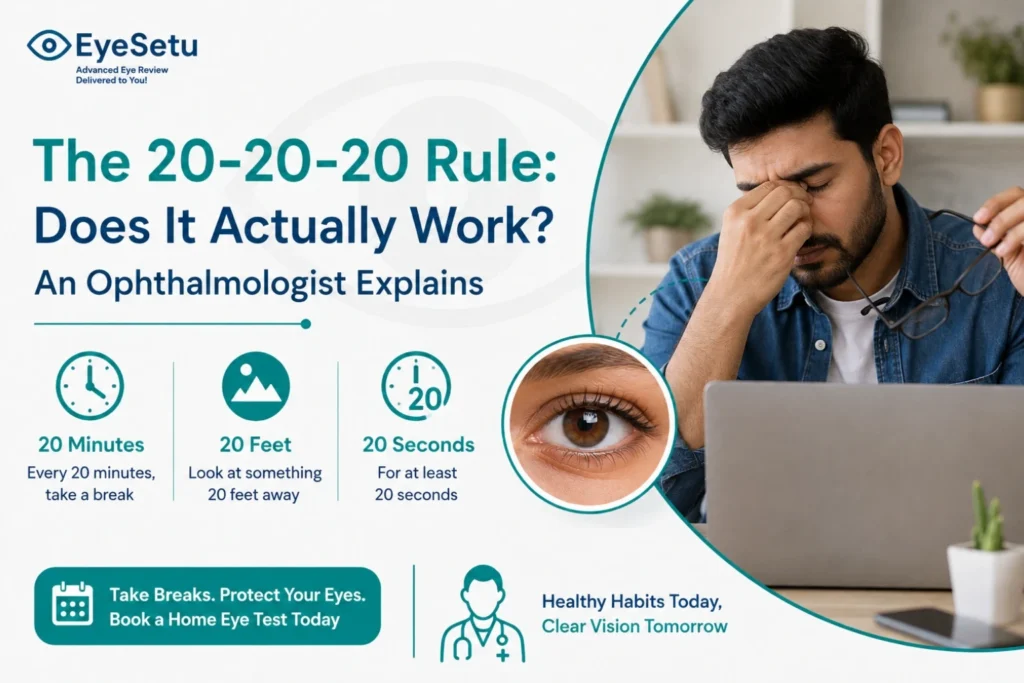
If you’ve spent any time on a screen in the last decade, you’ve probably heard the advice: every 20 minutes, look at something 20 feet away for 20 seconds. It’s simple, easy to remember, and gets repeated by everyone from opticians to office wellness posters. But does it actually do anything, or is it one of those health tips that’s more folklore than fact?
The honest answer is: it’s more nuanced than the confident way it’s usually presented. We put the question to Dr. Shikha Gupta, Co-Director at ICLINIX Group of Hospitals and Co-founder of EyeSetu, who trained in ophthalmology at AIIMS and has spent years fielding this exact question from patients managing long screen days. Here’s what the research actually shows, and what she recommends instead of treating the rule as gospel.
Where the 20-20-20 Rule Came From
The rule is aimed at reducing digital eye strain — a cluster of symptoms including dry eyes, blurred vision, headaches, and general eye fatigue that shows up after prolonged screen use. The idea is straightforward: sustained near-focus tires out the eye’s focusing muscles and reduces blink rate, so a periodic break looking at something farther away gives those muscles a chance to relax.
It’s a genuinely sensible concept. The question researchers have actually tested is whether the specific 20-20-20 formula is the right dose, or whether it’s more of a memorable slogan than a clinically proven protocol.
What the Research Actually Says
This is where it gets interesting. A well-known 2023 study published in Optometry and Vision Science tested people during a 40-minute reading task on a tablet, comparing breaks taken every 5, 10, 20, or 40 minutes. The results found no significant difference in reported eye strain symptoms, reading speed, or accuracy between the different break intervals — including no breaks at all during one session. The researchers were candid about this: despite how widely the rule is cited, there’s relatively little peer-reviewed evidence specifically supporting the 20-minute, 20-second, 20-feet formula.
That said, it’s not all bad news for the rule. A separate 2022 study in Contact Lens and Anterior Eye took a different approach — tracking computer users over two weeks using software that delivered personalised 20-20-20 reminders through the laptop’s webcam. That study found the approach was genuinely effective at reducing digital eye strain and dry eye symptoms during the study period, though the improvements faded within a week of stopping the reminders, and two weeks wasn’t long enough to produce measurable changes in underlying eye health markers.
A separate four-week study on tablet users found more encouraging results too — a majority of participants reported real relief in tired eyes, burning sensation, and headaches after adopting break-based habits, though a meaningful share of participants still had symptoms that needed further attention.
Put together, the fair takeaway is this: taking regular breaks from near-work does help most people with digital eye strain, but the exact “20-20-20” numbers aren’t a magic formula backed by strong evidence — they’re more of a useful, memorable starting habit than a precisely calibrated prescription.
“I still tell patients to follow the 20-20-20 rule, because it’s an easy habit to remember and it does no harm,” says Dr. Shikha Gupta. “But I’m honest with them that it’s not a cure-all. If someone’s eyes are genuinely strained after a full day of screens, the rule alone usually isn’t going to fix that — we need to look at their prescription, their screen setup, and how much of their day is actually spent indoors.”
For readers who want to look at the underlying research directly: the 2023 study in Optometry and Vision Science is on PubMed, and the 2022 Contact Lens and Anterior Eye study is available via ScienceDirect.
Does It Help With Myopia, Too?
This is a separate question from eye strain, and worth untangling. Some of the enthusiasm around the 20-20-20 rule has spilled over into myopia prevention — the idea being that regular breaks from near-work might also slow the progression of short-sightedness in children. The evidence here is genuinely still developing. Some research on optical defocus and eye growth suggests near-work breaks could plausibly help, but researchers studying this specifically have noted that 20 seconds every 20 minutes may simply not be enough time to make a meaningful dent in myopia progression — the outdoor-time and total-near-work-load factors appear to matter considerably more.
In other words, the 20-20-20 rule is a reasonable habit for comfort during long screen sessions, but it shouldn’t be treated as a substitute for the two things with much stronger evidence behind them: enough total outdoor time, and getting a child’s eyes properly checked and corrected if needed.
So What Should You Actually Do?
Rather than treating 20-20-20 as a strict clinical rule, it’s more useful to think of it as one piece of a broader set of habits:
Take breaks regularly, even if the exact timing varies. Whether it’s every 15 minutes or every 25, the core idea — interrupting sustained near-focus — is what matters more than the precise number.
Blink deliberately during screen use. Blink rate drops significantly during screen focus, which is a major contributor to the dryness that makes up a lot of “eye strain.”
Get your screen distance and lighting right. A screen held too close, or used in a dark room with a bright display, adds strain regardless of how many breaks you take.
Prioritise outdoor time, particularly for children, since this has a stronger evidence base for both general eye comfort and myopia prevention than break-timing alone.
Don’t self-diagnose persistent symptoms. If eye strain, headaches, or blurred vision continue despite reasonable screen habits, it’s worth getting an actual eye exam rather than assuming a better break schedule will fix it — sometimes what looks like screen fatigue is actually an uncorrected refractive error.
Quick Answers
Does the 20-20-20 rule actually reduce eye strain?
For most people, yes — taking regular breaks from near-work genuinely helps with digital eye strain, though research suggests the specific 20-minute interval isn’t a precisely proven formula so much as a useful, memorable habit.
Can the 20-20-20 rule prevent myopia in children?
It may help as part of a broader routine, but the evidence specifically for this rule preventing myopia progression is weaker than the evidence for outdoor time and regular eye check-ups, which remain the stronger recommendations.
What’s better than the 20-20-20 rule for eye strain?
No single habit outperforms the rest — a combination of regular breaks, deliberate blinking, correct screen distance and lighting, sufficient outdoor time, and an updated glasses prescription tends to matter more than any one rule followed strictly.
When Eye Strain Signals Something More
Occasional tiredness after a long screen day is normal. But if symptoms are frequent, getting worse, or not improving with basic habit changes, it’s worth ruling out an underlying issue — an outdated glasses prescription, dry eye, or in children, early myopia are all common and easily identifiable causes that no amount of screen breaks will fully resolve.
A proper eye exam settles this quickly. If your prescription is current, your eyes are healthy, and symptoms still persist, that’s useful information too — it usually points toward screen habits and environment rather than an underlying eye condition.
EyeSetu’s home eye testing service can check exactly this — vision, refraction, and general eye health — without needing to carve out a separate trip to a clinic. It’s a straightforward way to rule things out before assuming the fix is simply “take more breaks.”