Independence Day Special: Government Schemes for Free Eye Tests in India 2026
Every Independence Day, there’s a familiar wave of headlines about India’s progress — literacy rates, life expectancy, digital access. One number that gets far less attention is this: a large share of people who are visually impaired in India didn’t have to be. Most cases of blindness and low vision in this country are avoidable or treatable, and a good part of that gap comes down to something as basic as never having had an eye test.
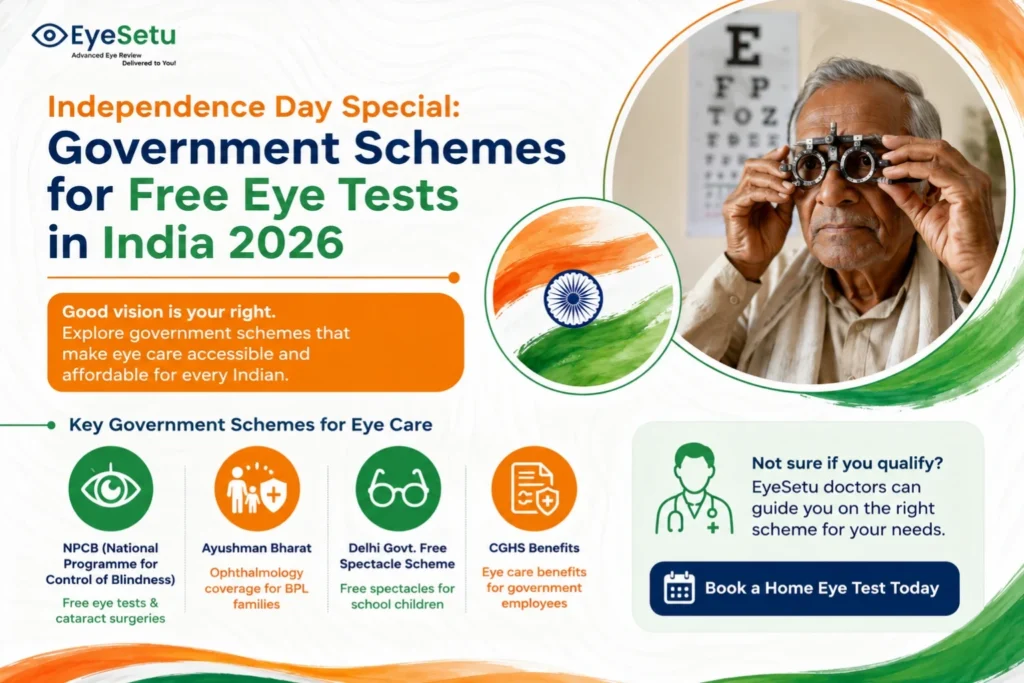
The good news is that India actually has a fairly wide safety net of government-backed eye care programmes. Most families simply don’t know these exist, what they cover, or how to access them. With this year’s Independence Day as a good reason to look into it, here’s an honest, practical rundown of the schemes offering free or heavily subsidised eye tests across the country in 2026.
National Programme for Control of Blindness and Visual Impairment (NPCBVI)
This is the backbone of India’s public eye care system. Running since 1976 with full central government funding, the programme has helped bring blindness prevalence down from around 1.1% in the mid-2000s to roughly 0.36% more recently, with a further target of 0.25% set for the years ahead.
Under NPCBVI, government hospitals and district blindness control societies typically offer:
- Free cataract surgeries, which remain the single largest cause of treatable blindness in India
- Vision screening and refraction services through primary health centres and vision centres
- Free spectacles for children from economically weaker families found to need them during school screening
- Screening and management support for glaucoma, diabetic retinopathy, and corneal blindness
The programme also runs school eye screening and refraction services, with trained teachers helping identify children who may need a closer look, and provides free spectacles to children with detected refractive errors from economically weaker families through district health society funding. If your child’s school has ever sent home a vision screening form, this is very likely the programme behind it.
School Health Programme Under Ayushman Bharat
Since school-going children are one of the groups most affected by undetected vision problems, the Ayushman Bharat School Health Programme works alongside NPCBVI in many states. Health and wellness teams — often trained teachers and ASHA workers — conduct periodic screenings covering vision, hearing, and general health, and refer children showing signs of refractive error to a specialist for a full check and, where needed, free glasses.
Coverage and consistency vary quite a bit from state to state and even school to school, so it’s worth asking your child’s school directly whether this screening happens on campus, and if not, when the last one was conducted.
Rashtriya Bal Swasthya Karyakram (RBSK)
RBSK is a broader child health screening initiative that specifically includes vision and eye conditions under its “4 D” framework — Defects at birth, Deficiencies, Diseases, and Developmental delays. Children from birth to 18 years, particularly those in government schools and anganwadis, are eligible for screening and referral through this programme, with treatment — including for conditions like squint, cataract, and refractive errors — provided free of cost at government facilities.
This is one of the more comprehensive schemes available for children, but again, awareness is the biggest barrier. Many parents simply don’t know that RBSK teams operating in their district can refer a child for a full eye work-up at no cost.
Ayushman Bharat – PM-JAY
While PM-JAY is primarily known for hospitalisation cover, it does extend to several eye-related surgical procedures, including cataract surgery, for eligible families under the scheme’s income and category criteria. Routine eye tests aren’t typically covered under PM-JAY the way they are under NPCBVI, but if a check-up reveals a condition requiring surgery, PM-JAY can significantly reduce or eliminate the financial burden for eligible households.
It’s worth checking your eligibility on the official PM-JAY portal or through your nearest empanelled hospital, since coverage depends on your state and category.
State-Level Eye Care Schemes
Several states run their own add-on programmes beyond the central schemes — free eye camps organised through district hospitals, mobile ophthalmic units that visit rural and semi-urban areas on a rotating schedule, and tie-ups with NGOs and eye hospitals for subsidised surgeries and spectacles. Delhi, for instance, periodically runs vision screening camps through government dispensaries and mohalla clinics, particularly around World Sight Day and similar health observances.
Because these vary by state and even change year to year, the most reliable way to find out what’s currently active near you is to check with your local district hospital, primary health centre, or your state health department’s website.
Who Should Actually Use These Schemes
Government schemes are especially valuable for:
- Families without health insurance or with limited disposable income for private eye care
- School-going children who haven’t had a formal eye test yet
- Senior citizens needing cataract evaluation or surgery
- Anyone with a known family history of glaucoma or diabetic eye disease who needs regular, affordable monitoring
- Rural and semi-urban households where the nearest private eye hospital is a significant distance away
That said, government schemes often come with longer waiting times, limited slots, and less flexibility around scheduling — understandably, given the scale they operate at. For families who can access private or home-based testing, that route often means faster turnaround and more convenient follow-ups, while government schemes remain an essential safety net for those who need it most.
How to Find Out What You’re Eligible For
If all of this feels like a lot to sort through, here’s a simple way to approach it:
- Start with your nearest government hospital or primary health centre. Ask specifically about NPCBVI screening camps, free cataract surgery slots, and vision centres in your area.
- Check with your child’s school about whether an RBSK or Ayushman Bharat School Health Programme screening has been conducted recently, and if not, when the next one is planned.
- Look up your state health department’s website for any active eye care camps or mobile ophthalmic unit schedules — these are often announced with fairly short notice.
- Check PM-JAY eligibility online if you anticipate needing surgery rather than just a routine check, since coverage depends on income category and state.
- Ask about eye donation and eye bank drives in your area too — these often run alongside screening camps and are a separate but related way many NGOs and hospitals engage communities on eye health.
None of these require an agent, a middleman, or a fee to find out about. A phone call to your local health centre is usually enough to get a straight answer.
Why This Matters Beyond Independence Day
The bigger picture here is a genuinely encouraging one. India has steadily built out a public health infrastructure aimed at making sure eyesight isn’t a privilege reserved for those who can pay for it. But infrastructure only helps if people know it exists and actually use it. A scheme that offers free spectacles to a child means nothing if the parent never finds out their child needed glasses in the first place.
This Independence Day, the most useful thing many families can do isn’t a symbolic gesture — it’s simply finding out whether they or their children are due for an eye check, and whether a nearby government scheme already covers it.
A Simpler Option for Those Who Can Access It
For families who’d rather skip the paperwork, waiting lists, or travel involved in government programmes — or who need a faster, more personalised experience — home-based eye testing has become a practical middle ground. EyeSetu’s AIIMS-trained team brings hospital-grade diagnostic equipment directly to your home in Delhi and Gurgaon, with results reviewed the same day by Dr. Shikha Gupta or another member of the ophthalmology team. It won’t replace the reach of a national programme, but for busy families, working professionals, or elderly patients who find hospital visits difficult, it solves the same core problem — getting tested — without the wait.
Dr. Shikha Gupta, Co-Director at ICLINIX Group of Hospitals and Co-founder of EyeSetu, has seen this gap up close over 15 years of practice, including her time as a senior consultant at AIIMS: “A large number of patients we see could have avoided vision loss entirely if they’d simply been tested a few years earlier. Government programmes have done a lot of the heavy lifting on access, but somebody still has to walk a family through which scheme applies to them. That’s the piece we try to help with, even when it means pointing someone toward a government facility instead of our own service.”
Whichever route you choose, the goal is the same: don’t let something this fixable go unchecked simply because nobody got around to it.
Where to Verify These Schemes Yourself
Rather than take any of this secondhand, it’s worth bookmarking the official sources directly:
- National Programme for Control of Blindness and Visual Impairment: india.gov.in/official-website-national-programme-control-blindness
- Ayushman Bharat – PM-JAY eligibility check: pmjay.gov.in
- Your state health department’s website, for local eye camp schedules and mobile ophthalmic unit routes
These are the same sources our team refers families to when a government scheme turns out to be the better fit than a private consultation.
Learn more about EyeSetu’s mission and team →