How Screen Time Is Secretly Damaging Your Child’s Eyes (And What AIOS Recommends)
If you’ve felt a quiet unease watching your child hunch over a tablet for hours, you’re not overreacting. The country’s top ophthalmology body has just confirmed it with data. During World Myopia Week 2026, the All India Ophthalmological Society (AIOS) released a new national consensus guideline titled “Prevention and Management of Childhood Myopia” — and the underlying message is hard to ignore: childhood short-sightedness in India is rising fast, and screen time is one of the biggest drivers behind it.
This isn’t a vague warning from a wellness blog. It’s a structured, evidence-based document from the same professional body that trains and represents India’s ophthalmologists, developed by leading paediatric eye specialists across the country. Here’s what it actually says, and what it means for your family.
What AIOS Actually Found
The guidelines were released to address what the society describes as an alarming surge in childhood myopia, both in India and globally. A few figures stand out:
- Myopia already affects close to one-fifth of the global population, and a significant share of that burden falls on children.
- Projections suggest that by 2050, nearly half the world’s population could be affected by myopia in some form.
- The risk of childhood myopia in India has reportedly doubled since the COVID-19 pandemic, a period that coincided with a sharp jump in screen-based learning.
- Today’s children commonly spend four to six hours or more on screens daily, often without any real attention to visual hygiene — things like screen distance, lighting, or breaks.
Dr Namrata Sharma, AIOS Chairman of the Scientific Committee and a professor at AIIMS Delhi’s RP Centre, has been vocal about the need to shift from treating myopia after it appears to actively preventing it — arguing that lifestyle changes remain the single most effective tool available, even as newer clinical treatments continue to be studied.
Dr. Shikha Gupta, Co-Director at ICLINIX Group of Hospitals and Co-founder of EyeSetu, who trained at AIIMS herself, sees this pattern echoed in the families she treats: “What we see repeatedly is that parents assume myopia announces itself clearly — a child squinting, complaining of headaches. In reality, most children adapt silently to blurry distance vision for months before anyone notices. The AIOS guidelines are a welcome push toward routine annual checks rather than waiting for a child to say something.”
You can read the full AIOS consensus statement, “Prevention and Management of Childhood Myopia,” on the society’s official site at aios.org.
Why Screens Specifically Are Under the Spotlight
Myopia isn’t caused by screens alone — genetics plays a real role, and children with myopic parents are statistically more likely to develop it too. But screen time acts as an accelerant, largely for two connected reasons.
Extended near-focus strain. Reading, writing, and screen use all require the eye to hold a close-focus position. Doing this for hours at a stretch, day after day, during the years when a child’s eyes are still developing, is associated with faster elongation of the eyeball — the actual physical change that causes myopia.
Less time spent outdoors. Every hour spent on a screen indoors is typically an hour not spent outside. Natural daylight and the habit of focusing on distant objects while playing outdoors appear to have a genuinely protective effect on eye development, independent of how much reading or close-up work a child does.
Online classes normalised long daily screen exposure at an age when it was previously rare, and for many households, that habit simply stuck around well after classrooms reopened — homework on tablets, YouTube, gaming, and general screen use to keep a child occupied while parents manage their own schedules.
What the AIOS Guidelines Actually Recommend
The 2026 guidelines lay out a fairly practical, low-cost set of recommendations rather than anything requiring expensive equipment or medication as a first step:
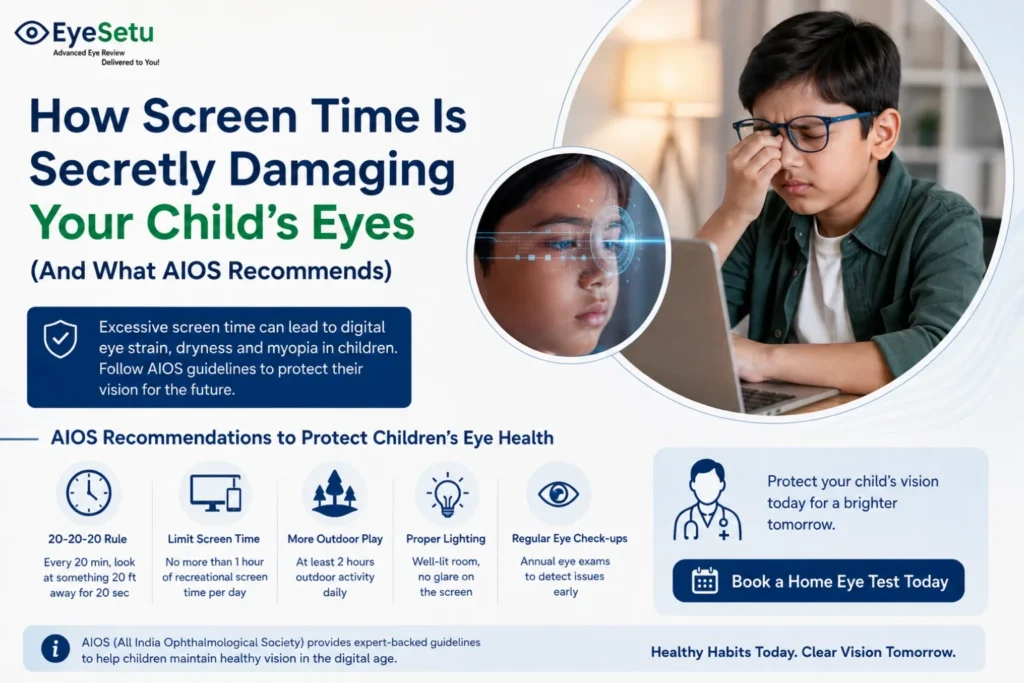
Annual eye examinations for all children, not just those already showing symptoms, since myopia in its early stages is often invisible to parents and even teachers.
School-based vision screening, recognising that schools are often the first place a vision problem gets noticed, given how much of a child’s day is spent reading a board or a book.
At least two hours of outdoor time daily. This is one of the most consistently repeated recommendations, and it isn’t a soft suggestion — it’s backed by research showing that outdoor light exposure appears to slow the eye elongation that drives myopia.
Limiting recreational screen time, distinct from screen use required for schoolwork, since recreational use tends to be the part most within a family’s control.
Maintaining proper reading distance and adequate lighting during study, both of which reduce unnecessary strain even when screen or book time can’t be avoided entirely.
Reinforcing the 20-20-20 rule — a 20-second break every 20 minutes, looking at something roughly 20 feet away — as a simple habit to reduce visual fatigue during long study or screen sessions.
For children whose myopia is already progressing quickly, the guidelines also acknowledge newer clinical approaches such as specific concentrations of atropine eye drops and specialised myopia-control lenses, though these are treatments an ophthalmologist would recommend and monitor directly, not something to attempt independently.
Signs Your Child’s Screen Habits May Already Be Affecting Their Eyes
Parents often don’t realise there’s an issue until it’s fairly advanced, simply because children rarely complain about something they’ve never known differently. Watch for:
- Squinting at the TV, whiteboard, or road signs
- Sitting closer than usual to screens or holding devices very near the face
- Frequent headaches, especially in the evening after school and homework
- Eyes that look tired, red, or watery after screen sessions
- Reduced interest in outdoor games, especially ones involving distant objects like cricket or badminton
- Comments from teachers about difficulty seeing the board clearly
None of these confirm myopia on their own, but any combination of them is a reasonable enough reason to book an eye check rather than wait for the next school screening cycle.
What Parents Can Actually Do This Week
The AIOS guidelines are aimed at ophthalmologists and policymakers, but the practical takeaways translate easily into daily habits:
- Set a rough daily cap on recreational (non-academic) screen time, and be consistent about it.
- Build outdoor time into the day deliberately — even a short walk or play session after school counts, and it adds up.
- Check that your child’s study area has good lighting and that screens or books are held at a comfortable distance, not closer than needed.
- Introduce the 20-20-20 rule as a household habit, not just a rule for your child — it works for adults staring at laptops too.
- Book an annual eye test even if nothing seems wrong, since myopia often develops gradually and painlessly before anyone notices.
Common Misconceptions Worth Clearing Up
A few myths tend to circulate among parents when this topic comes up, and it’s worth addressing them directly since they often delay a child getting checked.
“My child will grow out of it.” Myopia doesn’t resolve on its own. It typically progresses through the school years and stabilises in the late teens, but only once it stabilises — it doesn’t reverse. Glasses or contact lenses correct the symptom, and lifestyle measures can slow the progression, but “waiting it out” isn’t a strategy that works here.
“If their vision were really bad, they’d tell me.” Most children have no baseline for comparison. A child who has always seen the world slightly blurred at a distance assumes that’s simply how vision works for everyone. This is exactly why annual checks matter more than waiting for a complaint.
“Screen time for schoolwork doesn’t count the same as entertainment screen time.” From the eye’s perspective, near-focus strain doesn’t distinguish between a homework PDF and a cartoon. What matters is total near-work time and whether it’s balanced with breaks and outdoor time — the content on the screen is a separate parenting conversation.
“Blue light glasses will fix this.” Blue light filtering may help with general visual comfort for some people, but it isn’t a proven treatment for myopia progression. The AIOS guidelines don’t feature it as a core recommendation — outdoor time, screening, and proper visual hygiene are what the evidence actually supports.
Why Early Detection Changes the Outcome
Myopia caught and corrected early is one of the more manageable conditions in paediatric eye care. A child with a well-corrected prescription and reasonably healthy screen and outdoor habits can do everything their peers do without vision holding them back. Left unmonitored, though, progressive myopia during childhood is associated with a higher long-term risk of certain retinal complications later in life — which is exactly why the AIOS guidelines push so hard on the “prevention over treatment” message.
The most reassuring part of all this is that none of the recommended actions are complicated or expensive. Outdoor time, screen limits, better lighting, and a yearly check-up are well within reach for most families — the main barrier is usually just not knowing these guidelines exist, or assuming a child would say something if their vision were a problem.
Getting Your Child Tested Without Disrupting Your Week
A yearly eye exam sounds simple in principle, but for a lot of Delhi and Gurgaon families, fitting in a hospital visit around school and work schedules is where it quietly falls through the cracks. EyeSetu’s home eye testing service handles this by bringing hospital-grade equipment directly to your home, with a full vision assessment, refraction test, and eye health screening completed on the same visit, followed by teleconsultation with Dr. Shikha Gupta or another AIIMS-trained ophthalmologist on the team. For children already flagged for myopia monitoring, this also makes it realistic to actually keep up with the 3 to 6 month reviews that progressive cases usually need.
The AIOS guidelines make one thing very clear — prevention works, but only if it’s actually followed through on. A yearly test that keeps getting postponed doesn’t help anyone.