Back-to-School Eye Test: Is Your Child Ready to Learn?
New notebooks, a fresh timetable, that first-day uniform ironed and ready — most Delhi parents have a back-to-school checklist that covers almost everything except one thing that quietly decides how well a child actually copes in class: their eyesight.
Here’s the uncomfortable part. A child rarely walks up and says, “Mom, I can’t see the blackboard properly.” Most don’t know what clear vision is supposed to feel like, so they simply adjust — squinting, leaning forward, copying from a friend’s notebook, or losing interest in reading altogether. Teachers often mistake this for inattentiveness or slow learning, when the real issue is sitting three rows behind and unable to read a single word off the board.
If report cards have been a little inconsistent, or your child seems to “zone out” during homework, a simple eye check before the new term starts can rule out — or catch early — a problem that’s completely fixable.
Why Vision and Learning Are More Connected Than You Think
Roughly 80% of what a child learns in the classroom is absorbed visually — from the whiteboard, textbooks, worksheets, and screens. When vision isn’t sharp, that entire channel of learning gets disrupted, even if the child is bright, curious, and trying their best.
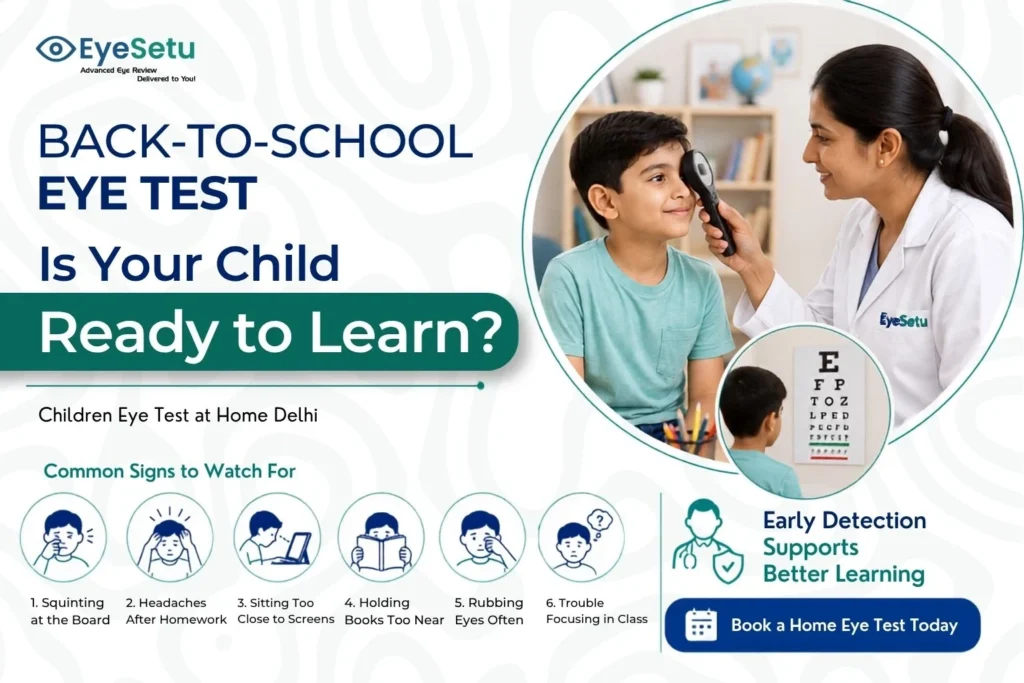
Uncorrected vision problems in children commonly show up as:
- Sitting unusually close to the TV or holding books very close to the face
- Frequent headaches, especially after school or homework
- Rubbing eyes often, or complaining of tired eyes by evening
- Losing their place while reading or using a finger to track lines
- Tilting the head or covering one eye to see better
- Reluctance to do near-work tasks like reading, colouring, or writing
- A sudden drop in academic performance with no clear reason
None of these symptoms automatically mean something is seriously wrong. But they’re worth checking, and a school reopening is the most natural time to do it — before habits like squinting or a poor sitting posture get baked in for the whole academic year.
What an Eye Test at Home Actually Involves
A lot of parents in Delhi still assume an eye test means taking time off work, driving across the city, and sitting through a long queue at a hospital OPD with a cranky, bored child. That’s exactly the gap a home eye test is built to close.
When EyeSetu’s team visits your home, the child eye test at home in Delhi typically covers:
Vision assessment — checking how clearly your child sees at different distances, using age-appropriate charts for younger kids who can’t yet read letters.
Refraction test — measuring whether the child needs glasses, and if so, the exact prescription strength required.
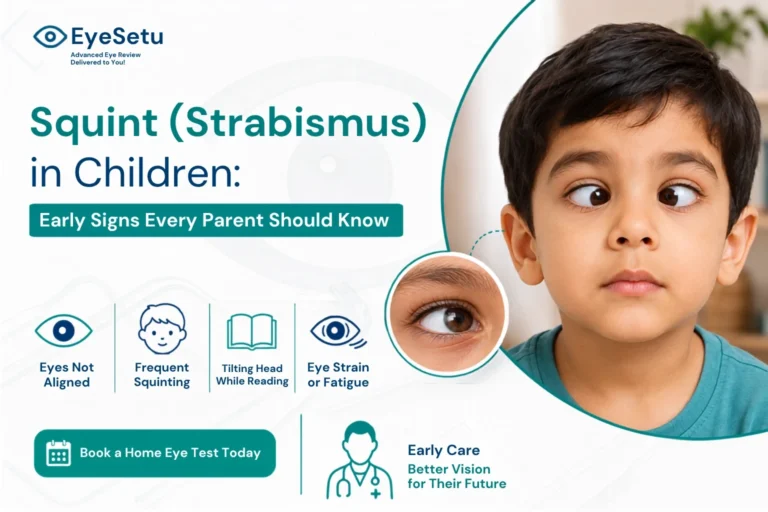
Eye muscle and alignment check — looking for squint or coordination issues between the two eyes, which can affect depth perception and reading ability if left unaddressed.
Basic eye health screening — checking for dryness, redness, allergies, or early signs of infection, all fairly common in school-going children.
Fundus and retina check where needed — a look at the back of the eye, which matters for children with a family history of high refractive errors.
The entire process takes about 20 to 30 minutes, is completely painless, and is conducted by trained professionals using the same equipment standards followed in clinics — just brought to your living room instead.
Why Convenience Actually Matters Here
It’s tempting to think of “eye test at home” as simply a nice-to-have. For families juggling school runs, office hours, and Delhi traffic, it’s often the difference between the test happening this month or getting postponed indefinitely.
A few reasons parents are choosing home testing over a hospital visit before this school session:
- No waiting rooms. Kids get restless fast in a clinical setting, which can affect how cooperative they are during the test — and that affects accuracy.
- Familiar environment. Children tend to respond better and stay calmer when tested in a space they’re comfortable in.
- Results and consultation on the same visit. Findings are reviewed with an eye specialist over video call right after testing, so you leave with clarity, not a follow-up appointment three weeks away.
- Easier for siblings. If you have more than one child, the whole family can be tested in a single home visit instead of multiple hospital trips.
- Better for anxious or first-time patients. A child who’s nervous about “doctor visits” is generally far more relaxed with a home-based check.
Signs Your Child Should Be Tested
Not every child needs urgent attention, but a few situations call for a test sooner rather than later:
- Your child has never had a formal eye check before starting school.
- There’s a family history of myopia, hypermetropia, astigmatism, or squint.
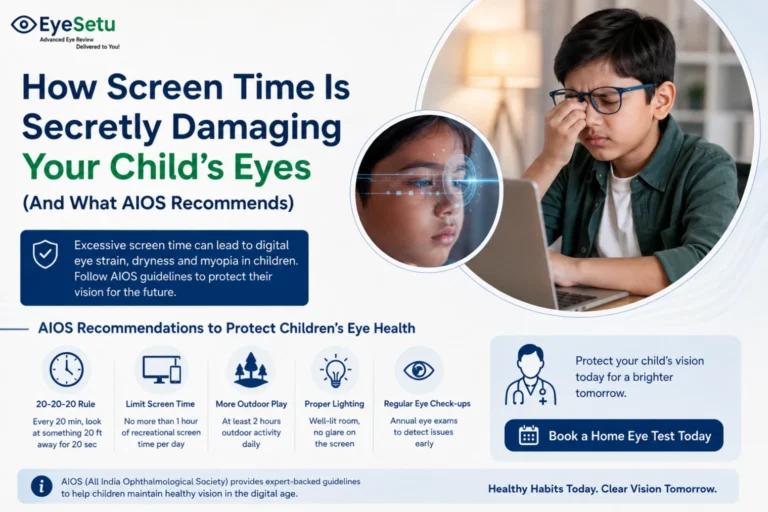
- Screen time — tablets, phones, or online classes — has increased noticeably over the last year.
- Teachers have mentioned the child struggles to copy from the board.
- Your child avoids reading or homework more than they used to.
- There’s visible squinting, eye rubbing, or unusual head tilting.
Even without any of these signs, ophthalmologists generally recommend a baseline eye check around the time a child starts school, followed by a review every one to two years — more frequently if glasses are already prescribed, since a child’s prescription can change as they grow.
What Happens After the Test
If your child’s vision is normal, you get peace of mind and a benchmark to compare against for future checks — genuinely useful, since it’s not always obvious when things gradually change. If a correction is needed, the process from diagnosis to glasses is kept simple: the ophthalmologist explains the prescription over video consultation, answers your questions, and can arrange for the right eyewear to be brought to you so your child isn’t starting the school term with blurry vision.
For children already managing conditions like squint, high refractive error, or lazy eye (amblyopia), regular follow-ups matter more than a one-time check. These conditions respond well to timely correction, but progress can be lost if reviews are skipped — something that’s easy to avoid when the follow-up test simply comes to your door every few months instead of needing a fresh hospital visit each time.
A Quick Checklist Before You Book
If you’re deciding whether this school session is the right time to get your child tested, run through this quick list:
- Has it been over a year since their last eye check, or has one never happened?
- Do they complain of headaches, tired eyes, or blurry vision by the end of the day?
- Has their screen time gone up compared to last year?
- Do you or your partner wear glasses, especially from a young age?
- Has a teacher mentioned anything about the child struggling to see the board or copy notes?
If you answered yes to even one of these, it’s worth booking a test now rather than waiting for a problem to become obvious. Vision issues in children are rarely dramatic — they show up as small, easy-to-miss adjustments a child makes without even realising it, and those adjustments can quietly shape how much they enjoy learning.
Frequently Asked Questions
At what age should a child have their first eye test? Most ophthalmologists recommend a baseline check by age 3 to 4, and definitely before a child starts formal schooling, since undetected issues at this stage can affect how naturally they pick up reading and writing.
How do I know if my child needs an eye test? Watch for squinting, sitting too close to screens, headaches after homework, or any comment from teachers about difficulty seeing the board. If your child has never been tested, that alone is reason enough.
Is a home eye test as accurate as a hospital visit? Yes. EyeSetu uses the same category of diagnostic equipment used in leading eye hospitals, and every test is reviewed by an AIIMS-trained ophthalmologist through teleconsultation.
How long does a children’s eye test at home take? Around 20 to 30 minutes per child, depending on age and cooperation. Younger children who can’t read letters are tested using picture-based or matching charts instead.
Will my child need to fast or prepare in any way before the test? No special preparation is required. It helps if the child is well-rested and not overly hungry or sleepy at the time of the visit.
How often should a school-going child be tested after this? Once a year for children with no known issues, and every 3 to 6 months for children already wearing glasses or being monitored for a condition like squint or amblyopia.
A functioning pair of eyes shouldn’t be the reason a capable child struggles in class. Before the new school term begins, it takes less than half an hour to make sure your child is actually seeing everything they’re expected to learn from.
Book a children’s eye test at home in Delhi with EyeSetu →
About the Author
Dr. Shikha Gupta is the Co-founder & CEO of EyeSetu and an ophthalmologist with over 15 years of experience in clinical practice and telemedicine. An AIIMS alumna (MBBS, MD Ophthalmology, Gold Medalist) and former Senior Consultant at AIIMS, she is dedicated to making quality eye care accessible through innovation, AI-powered retinal screening, and technology-enabled healthcare.
Medical Disclaimer
This article is intended for educational purposes only and should not be considered a substitute for professional medical advice, diagnosis, or treatment. If you experience changes in your vision or have concerns about your eye health, consult a qualified ophthalmologist for a comprehensive evaluation. Timely diagnosis and appropriate treatment remain the best way to protect your long-term vision.