Squint (Strabismus) in Children: Early Signs Every Parent Should Know
Somewhere between “he’s just being silly” and “she has a habit of tilting her head when she watches TV,” a lot of squints in children go unnoticed for months, sometimes years. It’s an easy thing to miss — squint doesn’t always look dramatic, and unless one eye is very obviously turned inward or outward, most parents don’t think to connect a slightly odd head tilt or a habit of covering one eye with an actual eye condition.
Squint, medically called strabismus, affects roughly 1 in 20 children, including infants. It’s genuinely common. The part that matters most for parents is this: squint responds very well to treatment, but only if it’s caught within a reasonably early window — generally before a child turns 7 or 8. After that, the window for full correction narrows considerably.
What Squint Actually Is
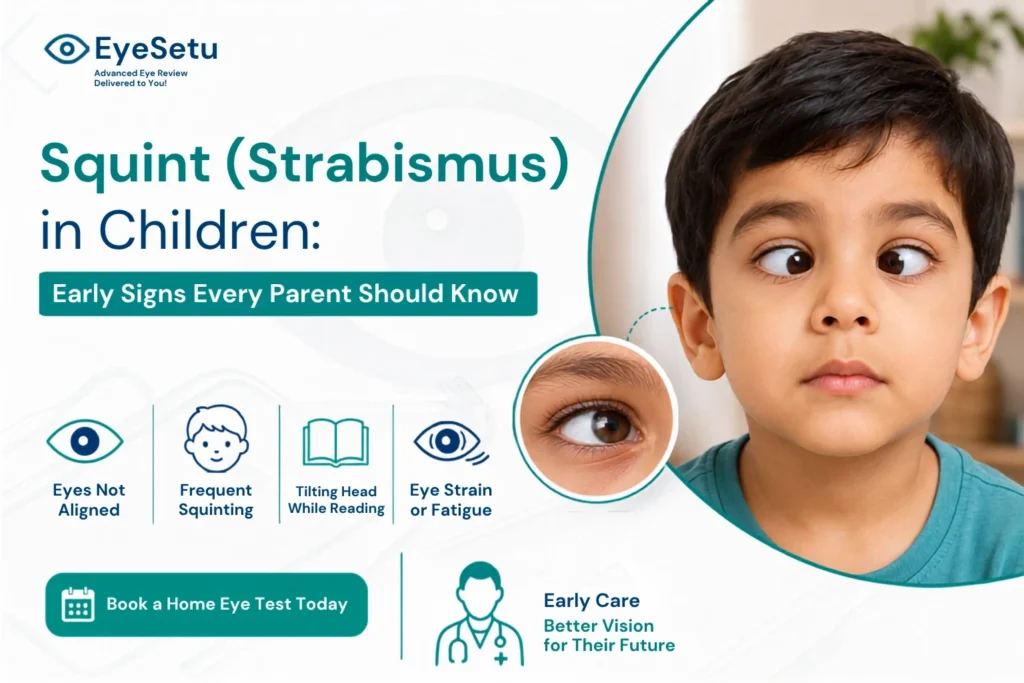
Strabismus is a condition where the two eyes don’t align in the same direction at the same time. While one eye looks directly at whatever the child is focused on, the other eye may drift inward, outward, upward, or downward. This misalignment can be constant or intermittent — some children only show it when they’re tired, unwell, or concentrating hard on something up close.
Most squints develop before age 3, though they can appear later in childhood too. Left unaddressed, a squint can lead to a second, related problem: the brain begins to ignore visual input from the misaligned eye to avoid double vision, and over time that eye effectively stops developing normal sight. This is called amblyopia, or lazy eye, and unlike squint itself, it can become permanent if it isn’t treated during the years the visual system is still developing.
Squint vs. Lazy Eye — What’s the Difference?
These two terms get used interchangeably, but they’re not the same thing, even though they’re closely linked.
Squint (strabismus) is a physical misalignment — the eyes point in different directions.
Lazy eye (amblyopia) is a functional problem — the brain suppresses input from one eye, leading to poor vision in that eye that glasses alone can’t fully correct.
Untreated squint is one of the most common causes of amblyopia in children, which is exactly why catching and treating squint early does double duty — it addresses the alignment issue and helps prevent the vision loss that can follow if it’s left alone.
Early Signs Parents Can Watch For
Squint can be subtle, especially in its early or intermittent stages. Some of the more common signs include:
- One eye appears to turn inward, outward, upward, or downward, even briefly
- The child tilts or turns their head to one side to look at things straight on
- Squinting or closing one eye, particularly in bright sunlight
- Difficulty judging distances — bumping into furniture or misjudging steps more than expected
- Complaints of double vision, more common in older children who can articulate it
- Eyes that don’t seem to move together when following an object
- In babies, eyes that appear crossed or wander outward constantly after the first 3 to 4 months of life
A useful (though not diagnostic) home observation: look at how light reflects off both eyes in a photo taken with flash. If the reflection point is noticeably different between the two eyes, it’s worth getting checked — this asymmetry is one of the signs ophthalmologists look for during an exam too.
Why Some Squints Are Easy to Miss
Not every squint looks like what most people picture. A few reasons it can slip past parents and even paediatricians during routine checkups:
- Intermittent squints may only appear when the child is tired, unwell, or doing intense near-work — easy to write off as a one-off.
- Small-angle squints can be genuinely hard to spot without a proper eye exam, especially in younger children who can’t describe what they’re experiencing.
- Pseudo-strabismus, common in babies with a wider nasal bridge, can make eyes look misaligned when they actually aren’t — which sometimes causes real squints to be dismissed as “probably nothing” too.
This is exactly why relying on visual observation alone isn’t enough, and why a proper paediatric eye exam matters more than trying to judge it by eye.
What Causes Squint in Children
Squint can happen for a range of reasons, and often it’s not any single cause but a combination:
Refractive errors, particularly uncorrected long-sightedness, which can cause the eyes to over-converge as the child strains to focus, sometimes resulting in an inward-turning squint.
Genetics, since strabismus tends to run in families — if a parent had a squint or needed glasses very young, their child has a somewhat higher chance of developing one too.
Underlying eye conditions, such as congenital cataract or retinal issues, which can cause poor vision in one eye and lead that eye to drift.
Neurological or developmental factors, in a smaller number of cases, particularly where squint appears alongside other developmental concerns.
In many cases, no single clear cause is identified, and that’s fine — treatment doesn’t necessarily depend on pinpointing the exact reason.
How Squint Is Treated
The right treatment depends on the type, severity, and underlying cause, but generally follows this order:
Glasses. If the squint is linked to a refractive error, particularly long-sightedness, corrective glasses alone can sometimes straighten the eyes by relieving the excess focusing effort. This is often the first and simplest line of treatment.
Patching. If amblyopia has developed alongside the squint, patching the stronger eye for a set number of hours each day forces the weaker eye to work, helping the brain relearn to use it properly. Duration varies from a few weeks to several months depending on severity and the child’s age.
Vision therapy. Structured eye exercises can help some children improve coordination between the two eyes, particularly for certain types of squint.
Surgery. For squints that don’t fully respond to glasses or patching, or where the misalignment is significant, surgery to adjust the eye muscles can help restore alignment and, in many cases, support the return of binocular vision. It’s a well-established, routinely performed procedure, and it can be combined with non-surgical treatment for the best outcome.
At ICLINIX Group of Hospitals, squint surgery is led by Dr. Varun Gogia, Director at ICLINIX and Chief Advisor to EyeSetu, who has performed the procedure across a wide range of paediatric cases over his career at AIIMS and beyond. Early screening, glasses, and non-surgical monitoring, on the other hand, is typically where Dr. Shikha Gupta and the EyeSetu team come in first — catching the condition early enough that surgery, if needed at all, has the best chance of a clean, lasting result.
Most children treated early achieve good, functional vision in both eyes long-term. The single biggest factor in outcome isn’t the type of squint — it’s how early it’s caught and treated.
“Parents often assume a squint means an immediate surgery conversation. In most of the cases I see, glasses or a patching routine, started early, are enough on their own,” says Dr. Varun Gogia. “Surgery is one tool among several, and the right approach really depends on catching the misalignment early and tracking how the child responds to the simpler options first.”
Why Timing Matters So Much
A child’s visual system develops rapidly in the first several years of life, and there’s a window — generally up to around age 7 or 8 — during which the brain’s visual pathways are still adaptable enough to respond well to treatment. Beyond that window, treating amblyopia becomes considerably harder, and vision loss in the affected eye can become permanent.
This is why paediatric ophthalmologists generally recommend regular vision screening starting from infancy, continuing through early childhood, rather than waiting for a squint to become visually obvious. By the time a squint is easy for a parent to spot without any training, useful treatment time may already have been lost.
Frequently Asked Questions
At what age does squint usually appear in children?
Most squints develop before age 3, though they can appear later. Any noticeable eye misalignment after 3 to 4 months of age is worth getting checked, since earlier treatment tends to produce better outcomes.
Can a child outgrow a squint on their own?
Generally, no. True strabismus doesn’t resolve by itself and needs assessment and, in most cases, active treatment. Some infants have pseudo-strabismus, which looks like squint but isn’t — only a proper exam can tell the two apart.
Is squint surgery painful or risky for children?
Squint surgery is a well-established, routinely performed procedure with a strong safety record. Recovery is generally quick, and it’s often combined with glasses or patching for the best long-term result.
Will my child need glasses even after squint surgery?
Possibly. Surgery corrects the physical alignment of the eyes, but if the squint was also linked to a refractive error, glasses may still be needed to maintain clear vision and support the correction.
How is squint different from lazy eye?
Squint is a physical misalignment of the eyes, while lazy eye (amblyopia) is reduced vision in one eye caused by the brain favouring the other. Squint left untreated is one of the most common causes of amblyopia in children.
What to Do If You Notice Any of These Signs
If you’ve noticed any signs of squint, however mild or occasional, it’s worth getting a proper eye exam rather than waiting to see if it resolves on its own — squint doesn’t reliably go away by itself, and the cost of waiting is measured in permanent vision, not just convenience. A paediatric eye exam typically includes a check of eye alignment, refraction to rule out uncorrected refractive errors, and where needed, a look at the back of the eye to rule out other underlying causes.
For families in Delhi and Gurgaon, EyeSetu’s home eye testing service brings this full assessment to your doorstep, with results reviewed the same day by Dr. Shikha Gupta or another AIIMS-trained ophthalmologist through video consultation — useful for young children who often do better with an exam in a familiar setting rather than a clinical one. If surgery does turn out to be the right path, EyeSetu coordinates the referral directly to Dr. Varun Gogia’s team at ICLINIX, so the diagnosis and the treatment stay connected rather than becoming two separate, disjointed visits.
Further Reading
For parents who want to go deeper on the clinical side, these are credible starting points: